What are some reasons to learn a new language in the New Year?

Here are 5 reasons to learn a new language in the New Year:

Improved communication:

Learning a new language can improve your ability to communicate with people who speak that language. This can be especially useful if you plan to travel to a country where the language is spoken or if you want to connect with people from a different cultural background.

Improved job prospects:

Being fluent in more than one language can be a valuable skill in the job market, as it can make you a more competitive candidate for certain jobs.

Improved brain function:

Studies have shown that learning a new language can have positive effects on cognitive function, including improved memory and problem-solving skills.

Cultural enrichment:

Learning a new language can also give you insight into the culture and history of the people who speak it. This can broaden your perspective and deepen your appreciation for other cultures.

Personal satisfaction:

Finally, learning a new language can be a rewarding personal accomplishment that can give you a sense of pride and accomplishment.

10 Tips for writing business emails in English

Here are 10 tips for writing business emails in English:

  1. Use a clear and concise subject line. This will help the recipient understand what the email is about and whether it is important or urgent.
  2. Use a professional greeting. “Dear [Name]” is a safe bet, but you can also use “Hi [Name]” if you have a more casual relationship with the recipient.
  3. Use proper English grammar and spelling. This includes using correct verb tenses, punctuation, and capitalization.
  4. Use bullet points or numbered lists to organize information. This makes it easier for the reader to scan and understand the content of your email.
  5. Use a professional closing, such as “Sincerely” or “Best regards,” followed by your name and contact information.
  6. Use a professional tone. Avoid using slang, abbreviations, or emoticons.
  7. Use a font and layout that is easy to read. Avoid using too many different fonts or colors, as this can make your email difficult to read.
  8. Use paragraphs to break up your text and make it easier to read.
  9. Proofread your email before sending it. This will help ensure that there are no mistakes or typos.
  10. Be mindful of cultural differences. Some words or phrases that are common in one culture may be considered inappropriate or offensive in another. It is always a good idea to be aware of these differences and to use language that is appropriate and respectful.

Why learn with English Online Training?

My name is Shaun. I am an experienced teacher who has worked with students around the world to help them achieve their learning goals. I will build up your confidence, your skills and your general business awareness and enable you to learn independently and successfully.

What do we do in the lessons?

Each person is different and I create an individual solution for each learner because what works for you might not work for everyone. We work together to analyse your needs, and create short term achievable goals, while working towards your long term aims.

The process is based on using real world examples based on your work and your experiences to create a truly unique lesson plan.

If you need to improve your presentations, then we learn about structure before practising in the class.

I could come to him with any questions, we had super interesting topics and a lot of fun in our English lessons.

If you need to improve your email writing, we look at yours and what you are sending to your business partners to see how we can improve.

If small talk is where you feel least confident, we will talk and talk and talk until you can chat with anyone or nearly any topic.

We work SMART – specific, measurable, achievable, relevant and time-based

How do you know if it’s working?

You will feel more confident very quickly and you will notice that you can do more in English.

One student told me that they can now watch the new season of their favourite series in English because of our lessons.

Another student got a promotion that they were denied before because of their language improvement

What are the benefits of choosing a teacher over choosing a language school?

Unlike a language school who may need to change teachers frequently or have a one size fits all approach to teaching, we will work directly together for as long as you need to achieve your goals. 

It is also probably less expensive as all the money you pay goes to the teacher rather than a large administration team.

What do my students say about me?

Taken from my linkedin profile

“Working with Shaun has been extremely helpful in my language development.

“A very patient teacher who makes it fun to learn and who makes the lessons varied. I can highly recommend.”

“Shaun was my English teacher for years and I learned a lot through him.

“I can only recommend Shaun as a teacher!”

“Lessons with Shaun where always fun, mostly because he adjusts them to his students’ needs and wishes. He supported me with HR Business English as well as small talk skills. Since Shaun is interested in a lot of topics, conversations with him usually taught me more than just English skills.

I could come to him with any questions, we had super interesting topics and a lot of fun in our English lessons.

A review of “How to teach business English: tips and techniques for developing yourself as a BE trainer with Helen Strong”

It was a beautiful summer day when we made our way down to Potsdam to hear Helen Strong give her workshop on “How to teach business English”. Despite the best efforts of Deutsche Bahn, it was a great turnout with around 30 teachers, trainers, language school owners and other miscellaneous ELTABB members attending down at the University of Potsdam. Helen herself had driven up from Ingolstadt the night before on her motorbike, so presumably was spared all public transport related dilemmas.


What I want to do in this review is describe the ideas that Helen put forward and also provide feedback of how it went when I put them into practise. On the day, we started off with speed networking; the classroom was rearranged into four rows of chairs, facing each other in two lines, with 3 questions provided by Helen, and three minutes to get the answer from the person opposite before the bell rang and we moved on to the next person. I really like it as an icebreaker; I ended up talking to ELTABB members that I had never spoken to before and what I especially like was that when the activity ended, Helen left us there in our new positions. It meant I went from my teacher’s pet position on the front row, right to the back row but it also meant I got out of my comfort zone of interacting with people that i already knew well. This is always a good thing!


I tried this out with two classes after the workshop and both times it was a success. The first group was actually a beginners group, and it still worked well. I asked them what they wanted to know when they met new people and we crowd sourced the questions. I also did with an intermediate group with some randomly chosen conversation questions. What I learned here was that I really needed a bell like Helen has. As she said it is important to explain the task beforehand, and I think the repetition aspect that is inherent in it really helps get learners going in a lesson.


The next discussion was about the difference between teachers and trainers. I don’t think it’s controversial to say there is a huge difference between teaching 30 school children and a 1-on-1 session with a business person. The way English language professionals approach this is still up for debate. The main point I took away from this was how we as workers shouldn’t undersell our knowledge and abilities, and also that it’s important that we are clear what they are for each of us.


The next section was about the importance of a needs analysis. Helen’s opinion was that this is a critical step for a taking on a new client as a BE trainer, and should be non-negotiable. We discussed the various ways you can carry out a needs analysis, including shadowing, interviews or questionnaires. I decided to test this with a potential new client of mine. I began with an interview with the department head. She was very clear that the workers needed English due to a switch in the computer systems in the company from German to English, which is happening in August. Before the workshop with Helen, this would have been enough for me to begin with. In this case, I decided to use the needs analysis form that had been provided by Helen.

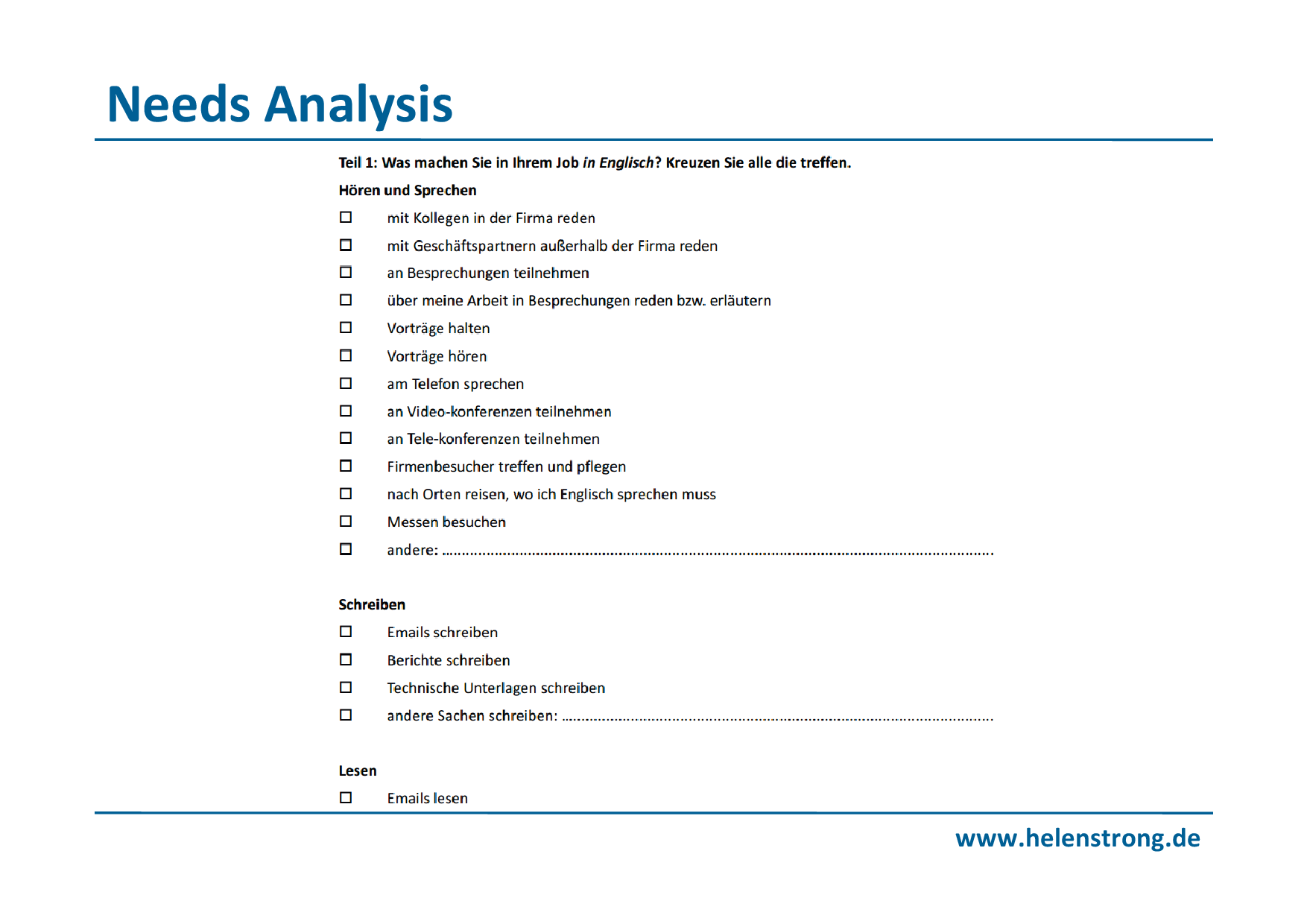
Part One looked like this

Teil 1

It’s a tickbox exercise covering many typical business interactions. I had twelve respondents, who I met for an individual face to face meeting, and what is interesting is that none of them mentioned computer systems, even after some gentle prodding from me. The biggest concern for nearly all of them was telephone English or speaking with English speaking colleagues. As this was different from I had initially been told, it already highlighted how useful this tool was going to be.


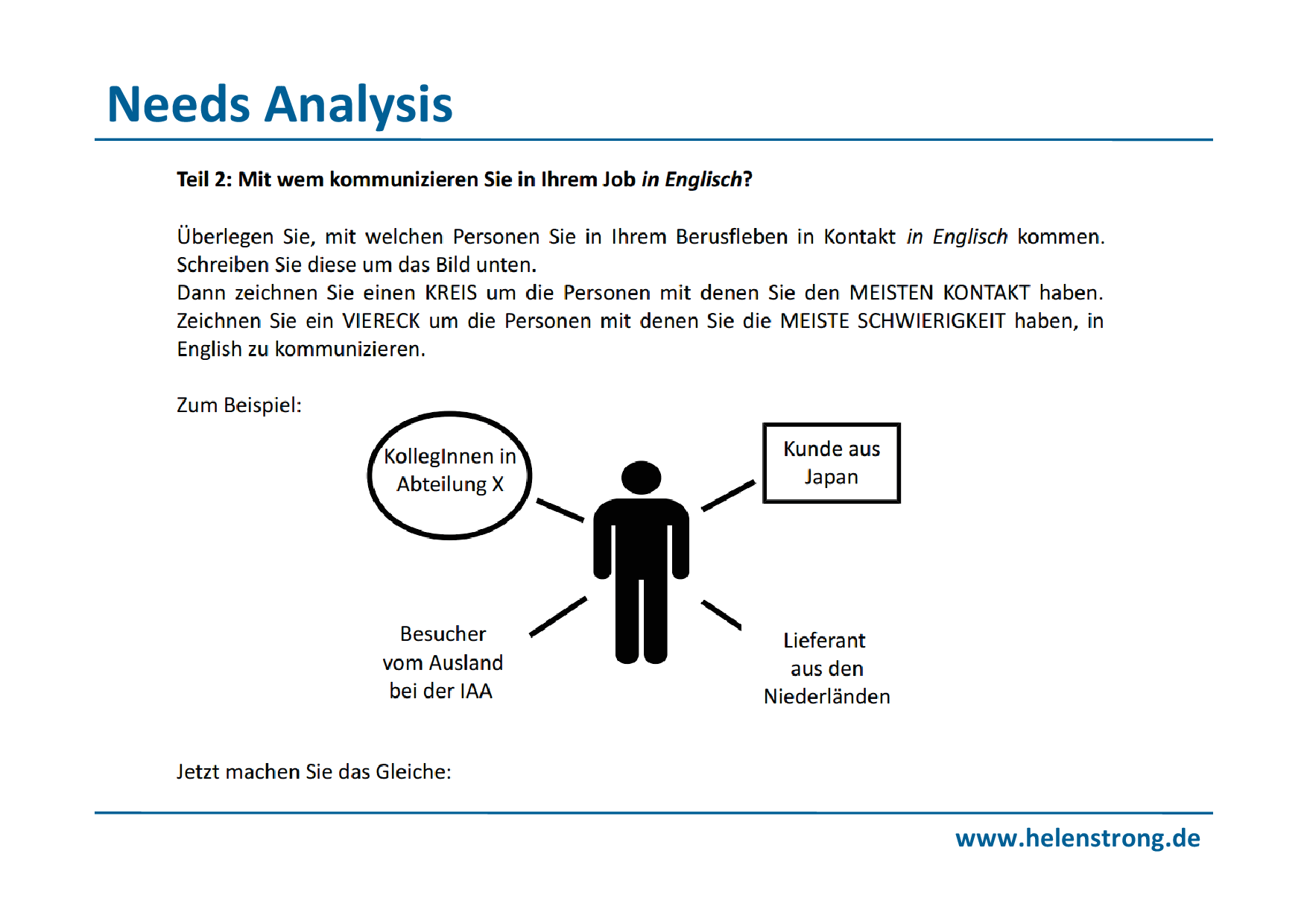
Part two caused some confusion at first, but after some explaining, and some thinking most got the gist of it. This particular cohort only only communicates with two groups of people in English: tenants and Swedish colleagues. So I didn’t get too much new information here, but I think that comes down to this particular situation. In a more varied international setting its value would increase a lot.

Teil 2

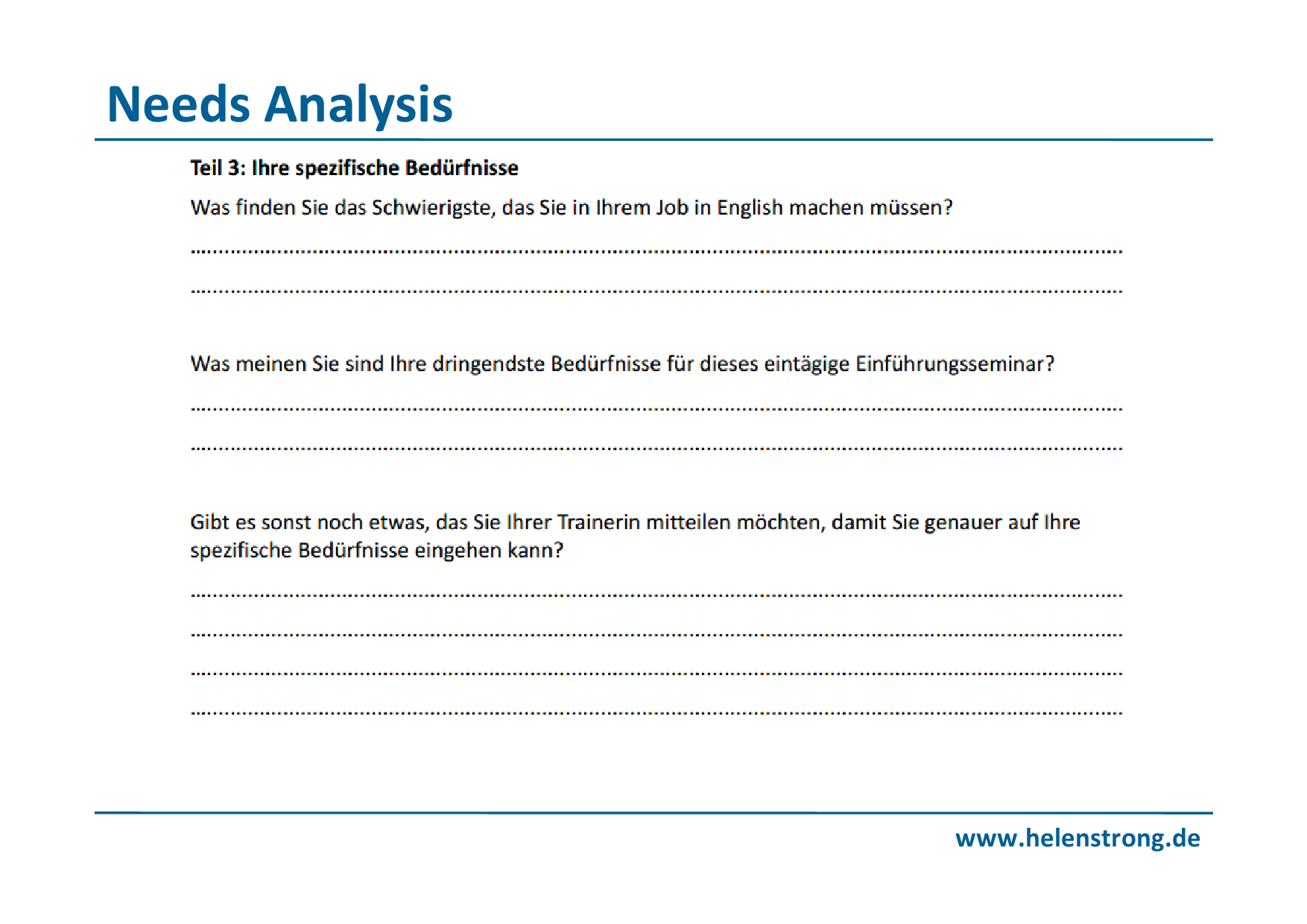
Part Three was particularly interesting. Again no mention of the forthcoming computer system change. However it provided a lot of topics will be used in upcoming lessons. The fact it was in German relaxed the students, although one was frustrated that she couldn’t express herself as she wanted in English. Overall I think that Helen’s advice to allow German at this stage is definitely sound advice. Different students used that permission to differing degrees, some wanting an early start to their practise, others wanting to get their reasons across in German.

teil 3.png

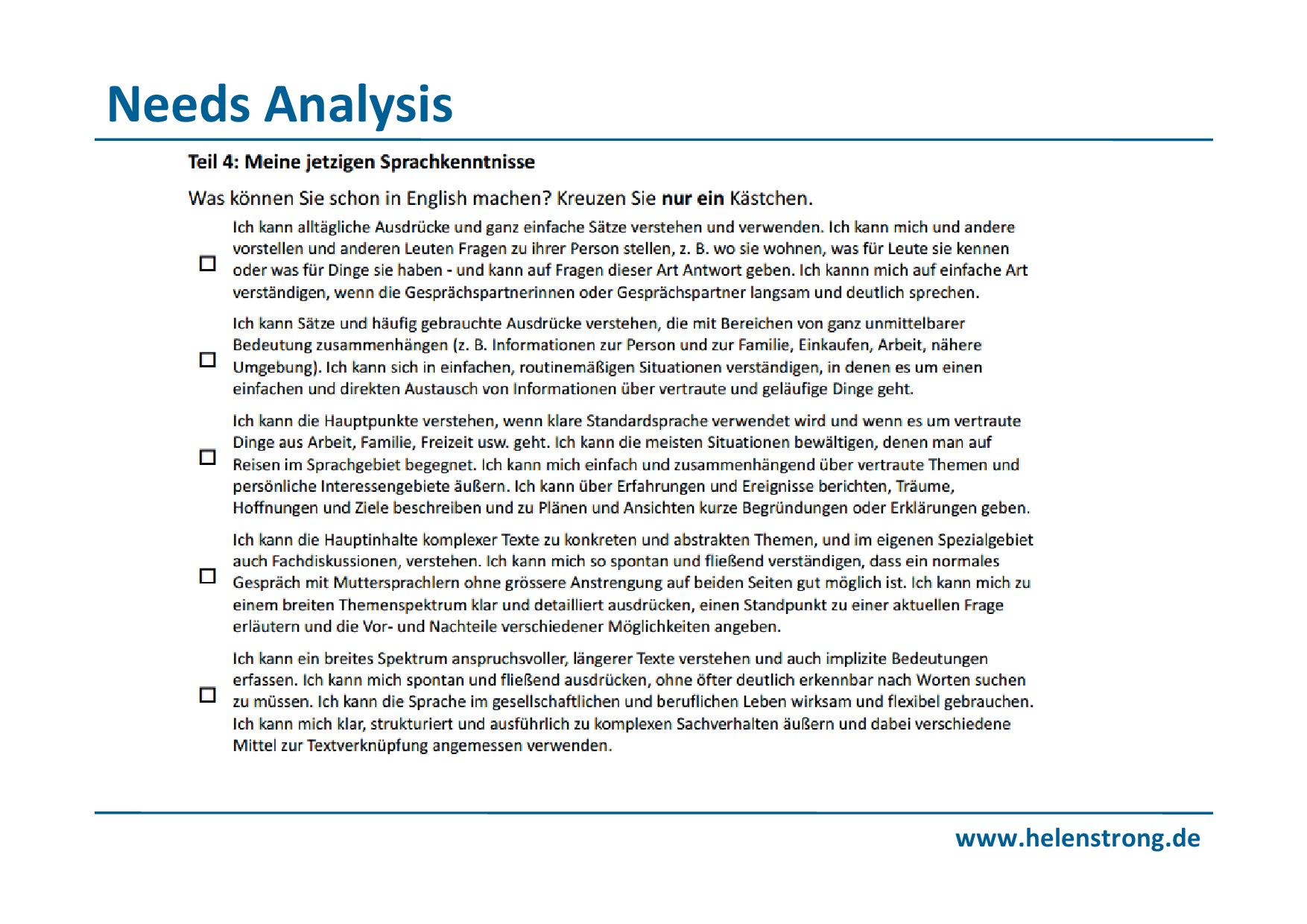
The final section was a description of English language capabilities taken from the CEFR framework. I have to be honest and say I didn’t get much benefit from this, except perhaps a small psychological insight. I found students were very poor at correctly identifying their ability. Some who used English very well were marking themselves as an A1 and others who couldn’t complete a sentence in English were marking themselves as B2. Obviously, there will always be outliers but I’m not sure if I would include it in a needs analysis of my own. Overall, I found the document to be a very useful tool for a BE trainer and I am now firmly on the needs analysis bandwagon.

teil 4.png

After all that, we had a break with a very nice spread laid on by the organisers. What I particularly liked was that Helen was very accessible here, as I had some questions that I wanted her opinion on. It was interesting to hear that networking brought in far more business for her than her website did. Which makes the next Stammtisch with ELTABB even more vital!


After the break we returned with a look at business skills starting with the six classic skills. What Helen did next which I found very interesting was transitioning these into functional skills. The business matrix that she used makes this very straightforward. The key point there sís inter… Rather than learning the six skills in solution, the suggestion is to see how these skills are usually used. I would highly recommend the use of her business skills matrix for devising training sessions when a specific purpose can be identified. Following this was a focus on culture in the workplace and a discussion of how these sometimes difficult issues could be addressed.


The penultimate segment dealt with the difference between International Business English (IBE), where at least one speaker has English as a first language, and Business English as a Lingua Franca (BELF), where none of the participant share English as a mother tongue. I found this idea very interesting, and getting the terminology made this different ideas more concrete. These particular issues and how you deal with them, are taking on increasing influence in Germany and particularly Berlin. The point being that communication and comprehension have to be the key as BE trainers. The week after I found myself saying to a student “That expression doesn’t exist in English” but when she asked me what was wrong, I had to admit there was no mistake. The sentence was grammatically and semantically sound. This prompted the workshop to pop into my head, and this reinforced my decision to change my mind with the reaction to the student. The sentence was acceptable International English, the other students, as well as me, had understood when it was spoken. What Helen Strong focused on, as I understood it,  was making students aware of what barriers to communication might exist, and her argument that language is really the last piece of the puzzle when it comes to BE training seemed particularly apposite here.


The workshop finished with a description of the Cert IBET, which the workshop took a lot of information from and Helen is a provider of. The pitch was good, especially as we all know how much Germany loves certificates! As Helen said, it is something which could make a trainer stand out from the crowd, and my feeling on the day was that some attendees were interested in having her return to Berlin to provide it. I think I might be one of them, so if there are any other like minded members we should discuss it (on Ning of course!)

Overall, there was a lot of interesting point discussed, and as I’ve shown, plenty which can be put into practise. What I liked the most, that I’m definitely planning on using is the business skills matrix, and the necessity of a needs analysis is now a firmly held belief.

What about you? What did you find interesting? Was there anything you disagreed with?  


Don’t forget to check out the slides from the workshop!


A way to make demonstrative determiners teachable | Oxford University Press

this, these, thatthose

If you’re not sure about this, these, that and those, the article highlights some interesting ways of looking at it in more detail. It’s useful for teachers and learners.

And then a colleague introduced me to the concept of summary nouns.

This/these + a summary noun

‘Abstract nouns with demonstrative determiners’, she informed me, ‘improve the flow of the text by summarizing old information and introducing it to a new clause or sentence.’ And then she gave me an example or two, such as the following:

An alternative to the guided interview is the focus group, in which respondents are asked to discuss their views collectively. This method, where participants engage with each other, has the advantage of lowering the risk of interviewer bias.

I must have been aware at some level of this feature of academic English, but I hadn’t actually had it explained to me as an entity in itself that was potentially teachable.

‘Oh, there are lots of things you can do with it in the classroom’, she added, such as:

– asking students to identify some of the many typical summary nouns (area, conclusion, development, example, idea, phenomenon, situation, trend etc.) and organizing them into sub-groups (claim, comment, remark etc.);

– gapping texts after the demonstrative determiner and eliciting the most appropriate summary noun;

– applying the feature to disconnected or ‘untidy’ texts;

– inviting students to bring in for discussion their own examples;

– looking at the occasions where a writer has paired that or those, or such instead of this or these with a summary noun.

And what I found in class was not only the sense among students that this was a feature they could take away for immediate use, but also, it seemed to me, a greater awareness of the function of demonstrative determiners in other contexts (on their own or with non-summary nouns), almost as if the ‘graspable’ nature of ‘this/these + a summary noun’ had acted as a kind of bridging device.

Source: A way to make demonstrative determiners teachable | Oxford University Press

Refusing to accept job ads for native speakers only: interview with Helen Strong – TEFL Equity Advocates

An interview with the head of the Munich English Language Teachers Association that makes a lot of sense. The native/non-native teacher argument is unnecessary.What matters is being a good enabler of English language acquisition.

The next step may be to communicate this with students who often state a request for British English in my lessons and compare it to Hochdeutsch. The idea that it is the standard or ´correct`version of English.

Source: Refusing to accept job ads for native speakers only: interview with Helen Strong – TEFL Equity Advocates

The Primary Differences Among Major International English Dialects | Grammarly Blog

Most English learners only think about American English and British English but that’s ignoring a huge amount of people who speak English as first language. Want to know more about the others?

There are several major dialects of English spoken internationally, each with its own unique characteristics. Some of the primary differences among these dialects include:

British English: This dialect is spoken in the United Kingdom and is characterized by its pronunciation, vocabulary, and grammar. One of the most notable features of British English is its use of Received Pronunciation (RP), which is a non-regional accent that is considered standard in the UK. British English also has a large number of words and phrases that are not used in other dialects, such as “lorry” for truck and “chemist” for pharmacy.

Australian English: This dialect is spoken in Australia and is heavily influenced by British English, but also has its own unique features. Australian English is known for its distinctive vowel sounds, such as the “flat” or “short” a sound in words like “dance” and “bath.” Australian English also has its own slang and colloquial terms, such as “fair dinkum” (genuine) and “she’ll be right” (it’ll be fine).

Canadian English: This dialect is spoken in Canada and is influenced by both British and American English. Canadian English is known for its use of “Canadian raising,” which refers to the raising of the diphthong in words like “about” and “house.” Canadian English also has its own distinct vocabulary, such as “parkade” for parking garage and “serviette” for napkin.

New Zealand English: This dialect is spoken in New Zealand and is heavily influenced by British English but also has its own unique features. New Zealand English is known for its use of “New Zealand rising,” which refers to the raising of the diphthong in words like “bath” and “dance” in a similar way to Australian English. New Zealand English also has its own slang and colloquial terms, such as “sweet as” (cool) and “chur” (thanks)

These are the major international dialects of English, but there are also many other dialects spoken around the world, each with their own unique characteristics, such as:

Singapore English: This dialect is spoken in Singapore and is heavily influenced by British English, but also has its own unique features. Singapore English is known for its use of “Singlish,” which is a mixture of English and various Chinese dialects, Malay and Tamil words and phrases. Singapore English also has its own distinct vocabulary, such as “kiasu” meaning “fear of losing” and “lah” which is used as a filler or an emphasis.

Indian English: This dialect is spoken in India and is heavily influenced by British English, but also has its own unique features. Indian English is known for its use of “Indian English,” which refers to the English spoken in India that incorporates many Indian words and phrases. Indian English also has its own distinct vocabulary, such as “chappal” for sandal and “chai” for tea. Indian English also has different pronunciations, and intonations compared to other dialects.

Filipino English: This dialect is spoken in the Philippines and is heavily influenced by American English, but also has its own unique features. Filipino English is known for its use of “Taglish,” which is a mixture of Tagalog and English. Filipino English also has its own distinct vocabulary, such as “jeepney” for public transport and “tricycle” for a type of three-wheeled vehicle. Filipino English also has different pronunciations, and intonations compared to other dialects.

It’s important to note that these dialects can vary greatly within the countries themselves, and that the above examples are generalizations. English is a global language and it’s spoken differently in every corner of the world, and each dialect has its own unique features that reflect the culture, history and influences of the region.

Did I miss any? Let me know in the comments

Source: The Primary Differences Among Major International English Dialects | Grammarly Blog

english online training

5 more reasons why native speakers need to learn to speak English internationally | ETp

As the world becomes increasingly interconnected, it is more important than ever for native English speakers to think about the international implications of their communication. Here are several reasons why this is important.

  1. Increased global interconnectedness: With the rise of technology and the internet, it is easier than ever to communicate with people from all over the world. Native English speakers need to be aware of how their communication may be perceived by people from different cultures, and make an effort to be sensitive to cultural differences.
  2. English as a global language: English is widely spoken and understood around the world, making it an important language for international communication. Native English speakers have a responsibility to use the language accurately and appropriately in order to promote effective communication and avoid misunderstandings.
  3. Cultural sensitivity: English speakers need to be mindful of the cultural context in which they are communicating. They should be aware of the cultural norms and expectations of their audience and avoid using expressions or idioms that may be considered offensive.
  4. Business communication: In today’s global economy, it is common for businesses to operate in multiple countries and cultures. Native English speakers working in international settings need to be able to communicate effectively with colleagues and clients from different cultures and backgrounds.
  5. Avoiding stereotypes: Native English speakers should be aware of the stereotypes associated with their own culture, as well as the cultures of those they are communicating with. They should avoid perpetuating these stereotypes in their communication and instead strive to understand and appreciate cultural differences.
  6. Building cultural bridges: Effective communication can help to build cultural bridges and promote understanding and cooperation between different cultures. Native English speakers have a responsibility to use their language skills to promote mutual understanding and respect.
  7. Promoting linguistic diversity: The use of English as a global language can sometimes lead to the suppression of other languages and cultures. Native English speakers should be aware of this and make an effort to respect and promote linguistic diversity.
  8. Adapting communication styles: Native English speakers should be aware of the different communication styles used in different cultures, and be prepared to adapt their own communication style accordingly.
  9. Professional and academic contexts: In professional and academic contexts, the way the message is delivered is as important as the message itself. Native English speakers should be aware of the conventions and expectations of their audience and adapt their communication accordingly.
  10. Empathy and understanding: Ultimately, effective international communication requires empathy and understanding. Native English speakers should strive to understand the perspectives and experiences of those they are communicating with, and communicate in a way that is respectful and inclusive.

In conclusion, native English speakers need to think about the international implications of their communication in order to promote effective and respectful communication with people from different cultures. This requires an awareness of cultural differences, an understanding of the role of English as a global language, and a willingness to adapt communication styles and avoid stereotypes. By being mindful of these issues, native English speakers can help to build cultural bridges and promote understanding and cooperation between different cultures.

For further reading, check out below:

In her blogpost this week, Chia Suan Chong looks at more reasons why native English speakers need to think about the international implications of their communication.

Source: 5 more reasons why native speakers need to learn to speak English internationally | ETp

Cartoon illustration of Berlin's cityscape, showcasing iconic landmarks and bustling streets with a playful touch, a perfect place to practice speaking English

Present: Simple or Progressive?

Present Simple and Present Progressive (AKA Continuous) are two fundamentals of English Grammar. Tenses, or time forms, are the thing that causes the biggest groans in English classes (looking at you “Present Perfect”). Here I want to look at the above two in a bit more detail.

When learning a language, people often like to compare it to what they know from their mother tongue. It’s not such an effective learning method, but when the two match up, it can give a reassuring feeling. If you are a German speaker then you have an advantage over many other language speakers when it comes to learning English as there are thousands of these “cognates“, shared vocabulary.

Unfortunately when it comes to grammar it’s another story. For example, while German has Präsens, English has Present Simple and Present Progressive (sometimes called Present Continuous). If you were to translate “I go” it would be “ich gehe” but “I am going” would give the same result. But this doesn’t mean “I go” and “I am going” mean the same thing. So what is the difference?
It comes down to this: Is the action happening one time, either now or in the future or is it a more general action, something that’s repeated, or simply a fact? Let’s think of an example.

Present Simple:   I       teach      English            in Berlin

↑             ↑                 ↑                      ↑

(Subject) (Verb) (Object)       (Circumstance)

(Circumstance just means the time or place where the action happened.)

This is a general situation; I go there everyday Monday to Friday and I’m not talking about any particular day.

Present simple with be:        I        am               an English Teacher              in Berlin.

↑         ↑                                       ↑                                    ↑

(Subject)  (Be)                             (Object)                   (Circumstance)

Here we have no main verb so before the object the verb “be” must be included.

Singular Be Plural Be
1st person I Am 1st Person We Are
2nd Person You Are 2nd Person You Are
3rd Person He/She/It Is 3rd Person They Are

Present Progressive:                I                    am          teaching              at school tomorrow

↑                     ↑                     ↑                          ↑                          ↑

(Subject)             (Be)             (Verb + Ing)       (Object)        (Circumstance)

In this case, I’m talking about a specific occasion i.e. tomorrow. It doesn’t suggest that I do it regularly, it’s only interested in tomorrow. It’s a one time situation.


Present Simple for Future

In “If” sentences, we use the Present Simple to talk about the future. e.g. We’ll get wet if it rains;I’ll get a drink if I go to the kitchen. ‘Rain’ and ‘go’ are the verbs and the action is in the future but we still use the Present Simple.

Another way to use Present Simple for the future is when you talk about things like the cinema and train times, things which are planned. E.g. What time does the film start? It starts at 8pm.When does the train come? Hopefully soon!

Present Progressive for Future

When something is happening in the future and it is planned and decided that it is definitely going to happen then the Present Progressive is the right tense to use. Often people use “Will” but this should be for actions which are a bit more spontaneous.

You can also use it when the action is just about to happen. E.g. I’m going to bed. You can be sitting on the sofa and yawning when you say this, it’s still fine!

How to know it’s Present Simple

Do is an indicator that the sentence is Present Simple. Questions need auxiliary verbs in English for example “Do” and “Be”.

To make a question  in Present Simple we use “Do” before the subject. E.g.

Do you work at an English language school?

  • Yes, I do. (short answer)         Or       Yes, I work at an English school. (Long answer)
  • No, I don’t. (short answer)      Or     No, I don’t work at English school. (Long answer)

If using a Question word (Who, What, Where, etc.) then Do is still before the subject.

What do you do?    When do you work?         Why do you think that?

Another sign is “How often” either in the question e.g. How often do you do sport or in the answer e.g. I walk past the gym every day.

We can look for time periods like everyday, on Mondays, every summer. We can also look for adverbs like often, always, sometimes which don’t really go with progressive tenses.

There are words which mean you do something by saying something. e.g. I promise, I apologise, I insist, I agree, I propose, I suggest etc. These words are for a one time action which is happening now, so logically it should be Present Progressive. But as you’ve probably realised by now, logic doesn’t get you too far with English.

How to know it’s Present Progressive

The way I think about it is “Is the action in progress?” It’s started but it hasn’t finished. I’m sitting in this chair. But if it’s something that’s still going on, even if it’s not happening now that still counts. E.g. I’m reading a book about English grammar at the moment. You can have a break from reading but it’s still there and you’ll (probably) go back to it.

Time periods like now, at the moment, this year, this summer, etc. are good indicators that it’s not a simple tense and therefore could be progressive. Can you think of any others?

If you want to talk about changes happening now, there are some words which usually go with Present Progressive. E.g. start, begin, rise, grow, become, fall, etc.

If you are talking about a temporary situation, you should be using the Present Progressive. I often hear “I am living in Berlin” from people who have spent their whole life here. This is not correct. If it’s a temporary situation like “I’m living in Berlin while I learn German” then that’s fine.

If someone plays computer games as normal hobby, then you would use Present Simple. If they are overdoing it you can say “You are always playing computer games!” This tells us that it’s just too much.

So what do you think? Is there a mistake that you know you sometimes make? Do you think English Grammar is difficult to learn? If you are looking for an English teacher in Berlin let me know!


Go back

Your message has been sent

Warning
Warning
Warning
Warning

Warning.