Starting your business as an immigrant presents a path filled with challenges, but also rich with rewards. The journey to entrepreneurial success is unique, with its own set of obstacles, yet your resilience and ingenuity equip you to conquer them. This guide from English Online Training is crafted to provide you with practical advice for navigating the business world. It aims to help you turn your vision into a successful, flourishing enterprise.
Simplifying Contractual Processes
The task of drafting and managing contracts can seem daunting. However, there are online tools that let you fill out and sign PDF contracts with ease, streamlining this process significantly. These tools facilitate a more efficient management of legal documents, enabling you to focus on core business activities. By leveraging these digital solutions, you can handle contracts confidently, ensuring clarity and precision in your business dealings. For instance, this tool allows for adding an e-signature for online forms, facilitating better communication while also making it easier to keep your records updated and digitally preserved.
Market Research Mastery
Understanding your market is key to business success. Conducting thorough market research helps you grasp consumer preferences and demands, tailoring your offerings to meet their needs. This knowledge empowers you to make informed decisions, positioning your products or services effectively within the marketplace. Grasping the nuances of your target audience is essential in creating a sustainable and profitable business model.
Establishing Trust and Credibility
For immigrant entrepreneurs, building credibility is a vital step towards long-term success. Establishing trust with customers, suppliers, and partners requires consistent effort and integrity. By delivering quality products and services, engaging transparently, and honoring commitments, you create a reputation of reliability. This trust is the foundation for lasting business relationships and growth.
Leveraging Local Support Networks
Don’t overlook the power of local support services and business networks. These platforms provide access to resources, mentorship, and networking opportunities, crucial for your business growth. Engaging with these communities offers insights into local market dynamics and connects you with other entrepreneurs, potentially leading to collaborations and partnerships that can propel your business forward.
Digital Marketing for Wider Reach
In today’s digital age, effective online marketing strategies are indispensable. As an immigrant entrepreneur, harnessing digital marketing tools can significantly expand your reach and enhance your online visibility. From social media marketing to search engine optimization, these strategies help you connect with a broader audience, driving traffic and increasing engagement with your brand.
Learning from Setbacks
In your entrepreneurial journey, setbacks are inevitable. Rather than seeing failures as defeats, consider them valuable lessons for learning and growth. When you embrace these experiences, they contribute to developing your resilience, adaptability, and wisdom. Each challenge you face serves as a crucial stepping stone, enhancing your skills and guiding you toward greater success.
Legal Navigation and Compliance
As an immigrant entrepreneur, it’s imperative to understand the legal intricacies of your new business environment. Consulting with a business attorney equips you with crucial insights on staying compliant and managing risks effectively. They can help you decipher complex regulations, ensuring your business operates within legal boundaries, thus safeguarding your venture from potential legal pitfalls.
As an immigrant entrepreneur, your potential for success is significant, even in the face of numerous challenges. Adopting strategies like embracing digital marketing, and simplifying contracts is key to turning your entrepreneurial aspirations into a prosperous business. Your journey encompasses more than just surmounting hurdles; it’s about creating a lasting legacy of success and innovation. This path leads not only to personal achievement but also to making a meaningful impact in the world of business.
In today’s fast-paced world, capturing and keeping your audience’s attention is a formidable challenge. The era of monotonous slide decks and lectures is fading, making way for innovative and interactive approaches to communication. Whether you’re an educator, professional, or simply someone looking to engage your audience in a more captivating manner, it’s time to embrace the power of alternative oral project formats.
In this article, we dive into a diverse range of creative alternatives to traditional presentations. From lively panel discussions and debates that stimulate critical thinking, to immersive storytelling experiences and interactive workshops, we’ll explore the exciting possibilities that can revolutionize the way you convey information and connect with your audience.
Join us as we break free from the shackles of the typical corporate boardroom or classroom setup. Discover how podcasts, role-playing, guided tours, and even mystery-solving games can transform your content delivery into an engaging, memorable, and dynamic experience. These alternative formats not only captivate your audience’s attention but also foster deeper understanding and active participation.
Say goodbye to dull presentations and hello to an array of vibrant options that invigorate, inspire, and leave a lasting impression. Let’s explore the untapped potential of these innovative oral project formats, and unleash the true power of effective communication.
So, are you ready to embark on this thrilling journey with us? Let’s delve into the world of alternative oral project formats and revolutionize the way we present information!
Interviews or Panel Discussions: Conducting interviews with experts, community members, or peers on a specific topic. You can also organize a panel discussion with multiple participants to explore different perspectives.
Debates: Organize a structured debate where participants argue for or against a particular issue or topic. This can be an engaging way to present information and stimulate critical thinking.
Podcasts: Create an audio recording or podcast episode where you discuss a subject, share stories, and incorporate interviews or discussions.
Storytelling: Share a personal or fictional story orally. This can be a great way to engage your audience and convey a message through narrative.
Demonstrations or How-To Guides: Show and explain a process, skill, or DIY project to your audience. This can be interactive and hands-on.
Speeches or Monologues: Deliver a persuasive speech, informative talk, or dramatic monologue to convey your ideas, beliefs, or emotions.
Role-Playing: Act out a scenario or role-play to demonstrate a concept or address an issue. This can be particularly effective for interpersonal or communication-related topics.
Public Service Announcements (PSAs): Create a short video or audio message aimed at raising awareness about a social issue or promoting a cause.
Audio Essays: Compose an audio essay or commentary where you explore a topic or issue through spoken words, incorporating sound effects or music to enhance the experience.
Storytelling through Visuals: Tell a story using visual aids like photographs, artwork, or a series of images while narrating the plot and its significance.
Guided Tours: Conduct a virtual or in-person guided tour of a place, museum, historical site, or even a virtual environment, providing information and context as you go along.
Interactive Workshops: Host a hands-on workshop where participants actively engage with the subject matter. This can involve group activities, discussions, and practical exercises.
Mystery or Problem-Solving Games: Create an interactive experience where the audience must solve a mystery or puzzle by following clues and participating in the storytelling.
Q&A Sessions: Instead of a traditional presentation, you can invite the audience to ask questions and engage in a dynamic, conversational Q&A session.
Show and Tell: Share personal or meaningful objects, artifacts, or experiences with the audience, providing context and stories related to each item.
Simulation or Role-Playing Games: Develop a scenario or game where the audience actively participates in making decisions and experiencing the consequences.
Cultural Showcases: Celebrate different cultures or traditions by presenting music, dance, food, and customs from a specific region or community.
Story Slam: Host a story slam event where participants share short, personal stories related to a theme or topic.
Elevator Pitch: Challenge participants to deliver a concise and compelling elevator pitch for a business idea, project, or cause.
Speech Choir: Organize a group of speakers who collectively present a speech or poem with synchronized delivery, emphasizing rhythm and expression.
Talk Show: Host a talk show-style discussion with guests, where you facilitate conversations and delve into a specific topic or issue.
Public Debates or Forums: Organize a public debate or forum where participants discuss controversial or important issues with audience interaction and questions.
Multimedia Storytelling: Combine spoken narration with visuals, videos, animations, and music to tell a compelling story or convey complex information.
Documentary-style Narration: Create a documentary-style audio or video narration, providing commentary, context, and insights on a specific topic.
Voices of the Community: Collect and present stories, interviews, and perspectives from members of a particular community to highlight their experiences and voices.
Digital Storytelling: Use digital tools and multimedia elements like video, animation, and interactive graphics to tell a compelling story or convey information.
Live Art Performance: Create art live while explaining your process and inspiration to the audience, whether it’s painting, sculpting, or any other art form.
These alternative oral project formats can be more engaging, interactive, and memorable than traditional presentations, making them suitable for a variety of educational and professional settings.
Are you looking to excel in the world of commercial real estate? Then mastering English is a must! In order to conduct successful deals and negotiations with clients, landlords, tenants, and investors, fluency in English is key.
You need to be able to effectively and confidently communicate your ideas, proposals, and offers. Whether it’s presenting a property in a persuasive and informative manner, negotiating the terms of a lease agreement, or writing a convincing email, strong English skills can make all the difference.
But it’s not just about language proficiency. The commercial real estate industry has its own vocabulary and jargon that you need to know in order to navigate it effectively. Terms like cap rate, NOI, and LOI are commonly used in the industry and can be confusing to those unfamiliar with them.
Therefore, taking an English for Commercial Real Estate course can be instrumental in advancing your career. Not only will it improve your language skills, but it will also help you develop a deeper understanding of industry terminology and practices.
With the right language skills and knowledge, you can gain a competitive edge in the commercial real estate industry and achieve your professional goals. So why wait? Start improving your English for Commercial Real Estate today!
a cityscape of berlin including the tv tower, in a cartoon style
What is commercial real estate?
Commercial real estate refers to properties that are used for business purposes, such as office buildings, retail spaces, warehouses, and industrial buildings. Unlike residential real estate, commercial real estate is purchased for the purpose of generating income, either through rental income or through the resale of the property at a higher price.
Commercial real estate is a large and complex industry that plays a crucial role in the economy. In this blog, we’ll take a closer look at what commercial real estate is, how it works, and the factors that influence its value.
Types of Commercial Real Estate
There are several types of commercial real estate, each with its own unique characteristics and investment potential.
Office Buildings:
These are the most common type of commercial real estate. They range in size from small buildings with a few tenants to large, high-rise buildings with hundreds of tenants. Office buildings are usually located in central business districts or in suburban areas with easy access to major highways and transportation.
Retail Spaces:
These are properties that are used for retail purposes, such as stores, malls, and shopping centers. They are often located in high-traffic areas with a large amount of foot traffic.
Industrial Buildings:
These are properties that are used for manufacturing, warehousing, and distribution purposes. They are often located in industrial areas with easy access to major highways and transportation.
Multi-Family Buildings:
Multi-family buildings are properties that are used for residential purposes, such as apartments and condominiums. They are often located in urban areas and are popular with investors because of their steady rental income.
Investing in Commercial Real Estate
Investing in commercial real estate can be a lucrative way to generate income and build long-term wealth. However, it is important to understand the risks and challenges involved in this type of investment.
One of the biggest challenges of investing in commercial real estate is finding the right property at the right price. It is important to conduct thorough research and due diligence to ensure that a property is a good investment opportunity.
Another challenge is managing the property once it has been purchased. This involves finding and managing tenants, collecting rent, and maintaining the property. Many investors choose to work with a property management company to handle these tasks.
Sustainability in Commercial Real Estate
Sustainability is becoming an increasingly important consideration in the commercial real estate industry. With growing concerns about climate change and environmental sustainability, many investors are looking for ways to incorporate sustainable practices into their properties.
There are several ways that sustainability can be integrated into commercial real estate. One way is through the use of green building practices. Green buildings are designed to be energy-efficient and environmentally friendly, with features such as high-efficiency lighting, water-saving fixtures, and renewable energy sources.
Another way to incorporate sustainability into commercial real estate is through the use of sustainable materials and construction practices. This can include using recycled or reclaimed materials, using sustainable wood products, and incorporating sustainable design features such as green roofs or rainwater harvesting systems.
In addition to environmental sustainability, social sustainability is also becoming a growing concern in the commercial real estate industry. This includes factors such as tenant comfort and health, community engagement, and social equity. Many investors are looking for ways to create spaces that are not only environmentally sustainable but also socially sustainable, with a focus on creating spaces that promote well-being and community.
Investors who incorporate sustainability into their commercial real estate properties can benefit in several ways. For one, sustainable properties are often more attractive to tenants and can command higher rents. Additionally, sustainable properties may be eligible for tax incentives or other financial benefits that can help offset the costs of incorporating sustainable features.
Overall, sustainability is becoming an increasingly important consideration in the commercial real estate industry. Investors who are able to incorporate sustainable practices into their properties may be able to benefit from increased demand and higher rents, as well as contribute to a more sustainable and resilient future.
Commercial Real Estate in Berlin
Berlin is a rapidly growing city with a thriving commercial real estate market. With a population of over 3.7 million people and a strong economy, Berlin is home to a diverse range of commercial real estate properties, including office buildings, retail spaces, industrial buildings, and multi-family residential buildings.
One of the key drivers of the commercial real estate market in Berlin is the city’s thriving tech industry. Many international tech companies have established a presence in Berlin in recent years, attracted by the city’s vibrant startup culture and affordable real estate prices. As a result, demand for office space in Berlin has been strong, with vacancy rates remaining low and rents continuing to rise.
Another factor driving demand for commercial real estate in Berlin is the city’s growing tourism industry. Berlin is a popular destination for tourists from around the world, with millions of visitors coming to the city each year. This has led to a strong demand for retail and hospitality properties, as well as for multi-family residential properties that can be used as short-term rentals.
Despite the strong demand for commercial real estate in Berlin, there are also challenges to investing in the market. One challenge is the limited supply of available properties, particularly in prime locations such as the city center. This has led to intense competition among investors and rising property prices.
Another challenge is navigating the complex regulations and zoning requirements in Berlin. As with many European cities, there are strict regulations governing the use and development of commercial real estate properties in Berlin. Investors must be prepared to navigate these regulations in order to ensure compliance and maximize their returns.
Overall, the commercial real estate market in Berlin offers both opportunities and challenges for investors. With a strong economy and growing demand for properties, Berlin is a promising market for investors looking to capitalize on the city’s growth. However, investors must be prepared to navigate the complexities of the market and carefully evaluate potential investment opportunities to ensure a successful outcome.
Questions for English learners
What is commercial real estate, and what types of properties does it include?
How has the COVID-19 pandemic affected the commercial real estate market?
What are the benefits of investing in commercial real estate, and what are some of the risks and challenges involved?
What are some of the key factors that drive demand for commercial real estate in different markets?
How can sustainability be integrated into commercial real estate properties, and what are the potential benefits for investors who do so?
What are some of the unique characteristics of the commercial real estate market in Berlin, and what opportunities and challenges does it offer for investors?
In der heutigen globalisierten Welt ist Englisch eine der wichtigsten Sprachen, die man beherrschen sollte. Es ist nicht nur die Sprache der internationalen Geschäftswelt, sondern auch die Sprache der Populärkultur und der Wissenschaft. Obwohl es eine Vielzahl von Möglichkeiten gibt, um Englisch zu lernen, ist es oft schwierig, den richtigen Ansatz zu finden. In diesem Blogbeitrag werden wir einige Tipps und Tricks vorstellen, die Ihnen helfen, einen erfolgreichen Start beim Englisch lernen zu haben.
Englisch lernen
Stellen Sie eine Lernroutine auf
Der Schlüssel zum erfolgreichen Erlernen einer neuen Sprache ist es, regelmäßig zu üben. Legen Sie eine feste Lernroutine fest und versuchen Sie, sich daran zu halten. Sie können sich beispielsweise entscheiden, jeden Tag 30 Minuten Englisch zu lernen oder jede Woche an einem Englischkurs teilzunehmen. Wichtig ist, dass Sie Ihre Lernzeit so planen, dass Sie nicht gestört werden und sich voll und ganz auf das Lernen konzentrieren können.
Nutzen Sie verschiedene Lernmethoden
Es gibt viele verschiedene Möglichkeiten, um Englisch zu lernen. Sie können englische Bücher lesen, englische Filme und Serien schauen, englische Podcasts hören oder sich mit einem englischen Sprachtandem-Partner treffen. Finden Sie heraus, welche Lernmethode am besten zu Ihnen passt und nutzen Sie verschiedene Methoden, um das Lernen abwechslungsreich zu gestalten.
Lernen Sie die Grundlagen
Bevor Sie sich auf kompliziertere Aspekte der Sprache konzentrieren, sollten Sie die Grundlagen lernen. Dies beinhaltet die englische Grammatik, den Wortschatz und die Aussprache. Stellen Sie sicher, dass Sie die Grundlagen verstehen, bevor Sie zu schwierigeren Themen übergehen.
Üben Sie mit anderen Menschen
Eine der besten Möglichkeiten, um Englisch zu lernen, ist es, mit anderen Menschen zu üben. Suchen Sie sich einen Sprachtandem-Partner oder besuchen Sie einen Englischkurs. Indem Sie mit anderen Menschen sprechen, können Sie nicht nur Ihre Sprachfähigkeiten verbessern, sondern auch wertvolle Einblicke in die Kultur und den Lebensstil von englischsprachigen Menschen gewinnen.
Haben Sie Geduld
Das Lernen einer neuen Sprache erfordert Geduld und Ausdauer. Es kann einige Zeit dauern, bis Sie Ihre Ziele erreichen. Machen Sie sich keine Sorgen, wenn Sie anfangs Schwierigkeiten haben oder Fehler machen. Seien Sie geduldig mit sich selbst und setzen Sie sich realistische Ziele.
Englisch zu lernen kann eine Herausforderung sein, aber es ist eine lohnende Investition in Ihre Zukunft. Mit einer Lernroutine, verschiedenen Lernmethoden, einer starken Grundlage, Übung mit anderen Menschen und Geduld können Sie Ihre Englischkenntnisse verbessern und Ihre Ziele erreichen. Probieren Sie verschiedene Ansätze aus und finden Sie heraus, was für Sie am besten funktioniert. Viel Glück beim Englisch lernen!
property manager working hard to look after buildings in a cartoon style
A quick guide on English and the property management industry
As a property manager, it is essential to have excellent communication skills, and it all starts with mastering the language of communication. English has become a universal language, and using it effectively in your line of work is crucial for success. Here are some tips on how to use English as a property manager.
Master the basics
It’s important to learn basic English rules such as sentence structure, tenses, and grammar. Having a good comprehension of these basics will make it easier for you to communicate effectively with anyone.
Keep it brief and concise
When speaking or writing in English, it’s important to keep your message brief and to the point. Long-winded communication can lead to confusion and misinterpretation. So, be clear and concise in your messages.
Learn property management terminology
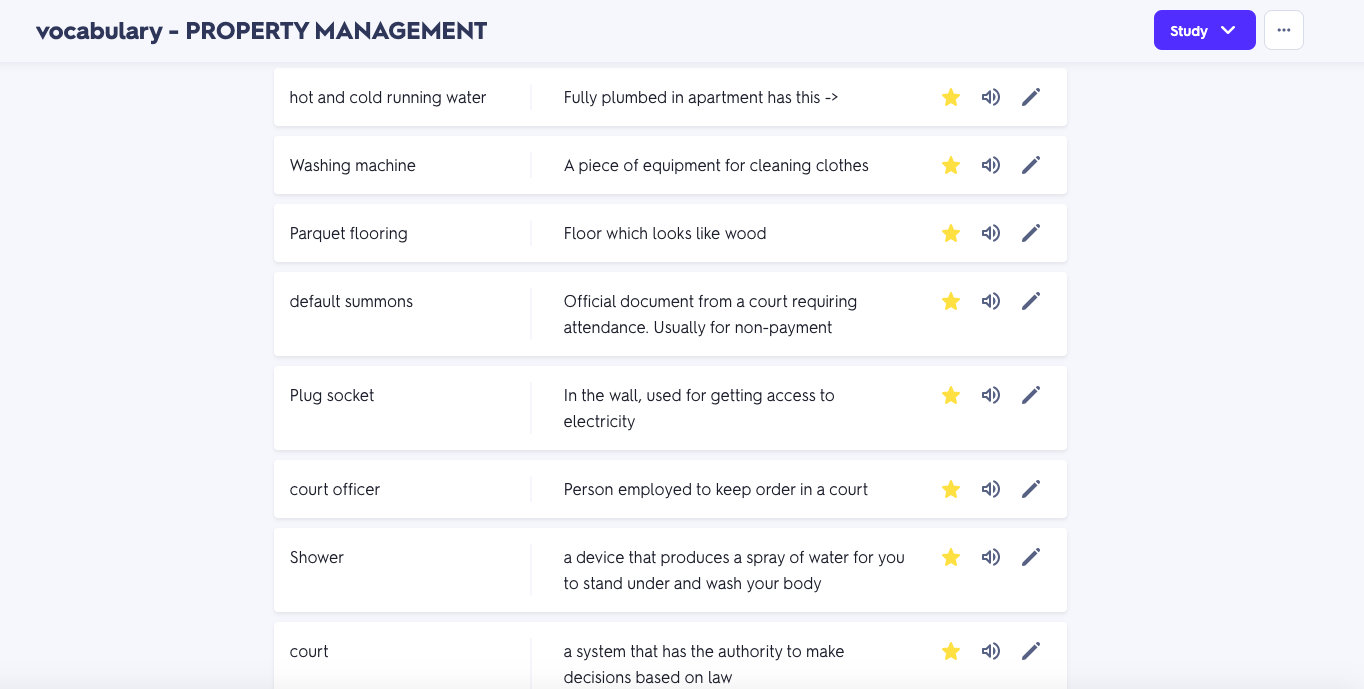
Property management has its terminology, and it’s essential to learn them. Understanding these terms will make communication easier between you and your clients, tenants, and other property management professionals. Follow the link if you want to practise
Download a pdf of property management vocabulary here
It’s crucial to understand the appropriate tone and language to use in different situations. For example, formal language is more appropriate when communicating with your clients or other professionals, whereas casual language is more suitable for communicating with your tenants.
Listen actively
Communication is a two-way street, and active listening is key. Listening carefully to your clients, tenants, and other professionals will help you understand their needs and suggest effective solutions.
Mastering English as a property manager will undoubtedly make you more effective in your line of work. So, take the time to learn and use these tips to communicate effectively with all involved parties in your property management career.
As you know, managing a property can be a complex task, and it requires a range of skills and knowledge to ensure success. From tenant relations to maintenance and repairs, property management involves a variety of responsibilities. Similarly, the construction industry is a challenging and dynamic field, requiring a range of skills and knowledge to complete a project successfully. In this blog post, we will explore various topics related to property management and the construction industry, including common challenges and best practices.
About Property Management
Property management involves overseeing a property’s day-to-day operations and ensuring that it remains profitable and well-maintained. Successful property management involves various aspects, including tenant relations, maintenance, and marketing. Here are some common challenges in property management and best practices to overcome them:
Maintenance: One of the most common challenges in property management is maintenance. Ensuring that a property is well-maintained is essential for attracting and retaining tenants. Regular inspections can help identify any maintenance or repair needs, and prompt action can help prevent more extensive damage. Responding promptly to maintenance requests is another critical aspect of successful property management.
Tenant Relations: Another essential aspect of property management is tenant relations. Building positive relationships with tenants can help improve tenant satisfaction and reduce the likelihood of disputes. Addressing tenant complaints and concerns promptly and professionally can help build trust and prevent potential conflicts.
Lease Agreements: Lease agreements are a critical aspect of property management. Lease agreements outline the terms and conditions of the tenant’s tenancy, including rent, security deposits, and lease terms. Consistent enforcement of lease terms and conditions is important to ensure that all tenants are treated fairly.
Tenant Screening: Screening potential tenants is another essential aspect of property management. Thoroughly screening potential tenants before approving their application can help ensure that they are a good fit for the property and reduce the likelihood of problems down the line.
Property Appraisal: Property appraisal is the process of evaluating a property’s value. Property appraisals are necessary for various reasons, including determining the rental rate for the property and marketing the property to prospective tenants.
Managing a property or overseeing a project requires a range of skills and knowledge. From tenant relations to project management, there are many challenges to overcome. However, by implementing best practices and prioritizing communication and transparency, property managers can ensure success.
Test your knowledge of the property management industry
By taking our quiz and stay updated on industry news by subscribing to our newsletter.
In addition, as an English speaker, you have an advantage in the property management industry, as English is the language of business worldwide. Being proficient in English will allow you to communicate effectively with a diverse range of clients, contractors, and stakeholders. Therefore, it’s wise to invest in English language courses or materials to enhance your communication abilities and increase your marketability as a property manager.
Processing…
Success! You're on the list.
Whoops! There was an error and we couldn't process your subscription. Please reload the page and try again.
In conclusion, property management is a complex and challenging field requiring a range of skills and knowledge. However, by implementing best practices, prioritizing communication and transparency, and investing in improving your English proficiency, you can ensure success and excel in your career as a property manager. Stay tuned for more blog posts on property management and the construction industry.
The SME Climate Hub is an initiative of the We Mean Business Coalition, the Exponential Roadmap Initiative, the United Nations Race to Zero campaign and the International Chamber of Commerce. This partnership is an exercise in radical collaboration that opens the doors for SMEs to join the United Nations Race to Zero campaign — an international campaign that brings together an unprecedented coalition of real economy actors and 120 governments committed to achieve net-zero emissions by no later than 2050.
In collaboration with the Net Zero team at Oxford University, the SME Climate Hub provides tools and resources to enable SMEs to make a climate commitment, take action and measure their progress. It is our belief that climate action is everyone’s business. We know that many businesses like ours are faced with the challenge of transitioning to a low-carbon economy. But we also know that SMEs are vital in driving change and will play a key role in achieving the net zero targets set by the UK government.
That’s why we’re proud to have signed up to the SME Climate Commitment, meaning we’re ready to take action to reduce emissions, develop green energy initiatives and engage with new green technologies.
The SME Climate Hub has been created to help SMEs meet the commitment.
By joining the SME Climate Hub, we’ll get access to a range of tools and resources, such as:
-A way to measure, track and report our carbon emissions – Advice on setting targets – Access to green energy initiatives – Monthly webinars from experts on relevant concepts – A forum to support discussion, problem-solving, and collaborative action
We’re confident that through tools such as these we’ll achieve our net zero goals and contribute to helping the EU become as climate-friendly as possible
We’re proud to have made the SME Climate Commitment. Join me and get access to a range of tools to plan how you’ll get to net zero: @SMEClimateHub
The more you practice, the more comfortable you will become with the language. Try to speak English as much as possible, whether it’s with native speakers or other learners.
Improve your vocabulary:
The more words you know, the more easily you will be able to express yourself. Try reading books, watching movies, or listening to podcasts in English to expose yourself to new words and phrases.
Immerse yourself in the language:
Surround yourself with English as much as possible. Listen to music, watch TV shows and movies, and try to find opportunities to speak with fluent speakers.
Be patient:
Learning a new language takes time and effort, so be patient with yourself and don’t get discouraged. With practice and dedication, you can become more fluent in English.
Listen to fluent or native level speakers:
Pay attention to how they use the language, including their intonation, stress, and rhythm. This will help you develop a better sense of how the language sounds and how to use it more naturally.
Find a language exchange partner:
Practice speaking with someone who is learning your native language. This will give you the opportunity to speak English in a low-pressure setting and receive feedback on your pronunciation and grammar.
Take an English course:
Consider taking a online English course with Shaun Trezise. This will provide you with structured lessons and feedback from a teacher who offers a personalized approach to cater to each student’s unique learning style and needs.
Use English as much as possible:
Try to use English as much as possible in your daily life. This could include setting your phone and computer to English, listening to English-language music, or joining an English-language club or group.
Don’t be afraid to make mistakes:
It’s natural to make mistakes when learning a new language, so don’t be afraid to try new things and make errors. The more you practice, the more comfortable you will become with speaking English.
Any questions? Comment below or contact me shaun@learnenglishinberlin.com
Here are 5 reasons to learn a new language in the New Year:
Improved communication:
Learning a new language can improve your ability to communicate with people who speak that language. This can be especially useful if you plan to travel to a country where the language is spoken or if you want to connect with people from a different cultural background.
Improved job prospects:
Being fluent in more than one language can be a valuable skill in the job market, as it can make you a more competitive candidate for certain jobs.
Improved brain function:
Studies have shown that learning a new language can have positive effects on cognitive function, including improved memory and problem-solving skills.
Cultural enrichment:
Learning a new language can also give you insight into the culture and history of the people who speak it. This can broaden your perspective and deepen your appreciation for other cultures.
Personal satisfaction:
Finally, learning a new language can be a rewarding personal accomplishment that can give you a sense of pride and accomplishment.
It was a beautiful summer day when we made our way down to Potsdam to hear Helen Strong give her workshop on “How to teach business English”. Despite the best efforts of Deutsche Bahn, it was a great turnout with around 30 teachers, trainers, language school owners and other miscellaneous ELTABB members attending down at the University of Potsdam. Helen herself had driven up from Ingolstadt the night before on her motorbike, so presumably was spared all public transport related dilemmas.
What I want to do in this review is describe the ideas that Helen put forward and also provide feedback of how it went when I put them into practise. On the day, we started off with speed networking; the classroom was rearranged into four rows of chairs, facing each other in two lines, with 3 questions provided by Helen, and three minutes to get the answer from the person opposite before the bell rang and we moved on to the next person. I really like it as an icebreaker; I ended up talking to ELTABB members that I had never spoken to before and what I especially like was that when the activity ended, Helen left us there in our new positions. It meant I went from my teacher’s pet position on the front row, right to the back row but it also meant I got out of my comfort zone of interacting with people that i already knew well. This is always a good thing!
I tried this out with two classes after the workshop and both times it was a success. The first group was actually a beginners group, and it still worked well. I asked them what they wanted to know when they met new people and we crowd sourced the questions. I also did with an intermediate group with some randomly chosen conversation questions. What I learned here was that I really needed a bell like Helen has. As she said it is important to explain the task beforehand, and I think the repetition aspect that is inherent in it really helps get learners going in a lesson.
The next discussion was about the difference between teachers and trainers. I don’t think it’s controversial to say there is a huge difference between teaching 30 school children and a 1-on-1 session with a business person. The way English language professionals approach this is still up for debate. The main point I took away from this was how we as workers shouldn’t undersell our knowledge and abilities, and also that it’s important that we are clear what they are for each of us.
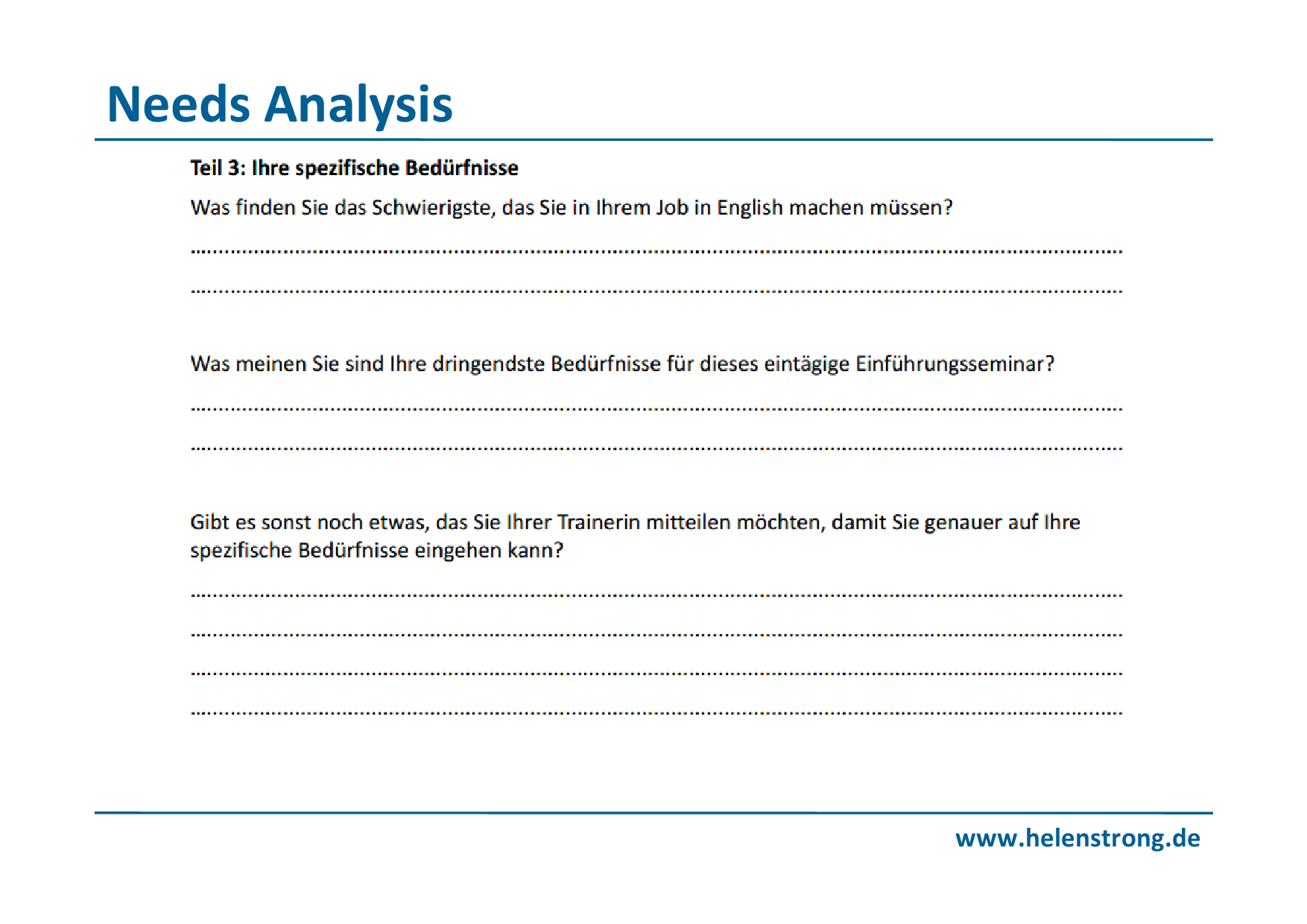
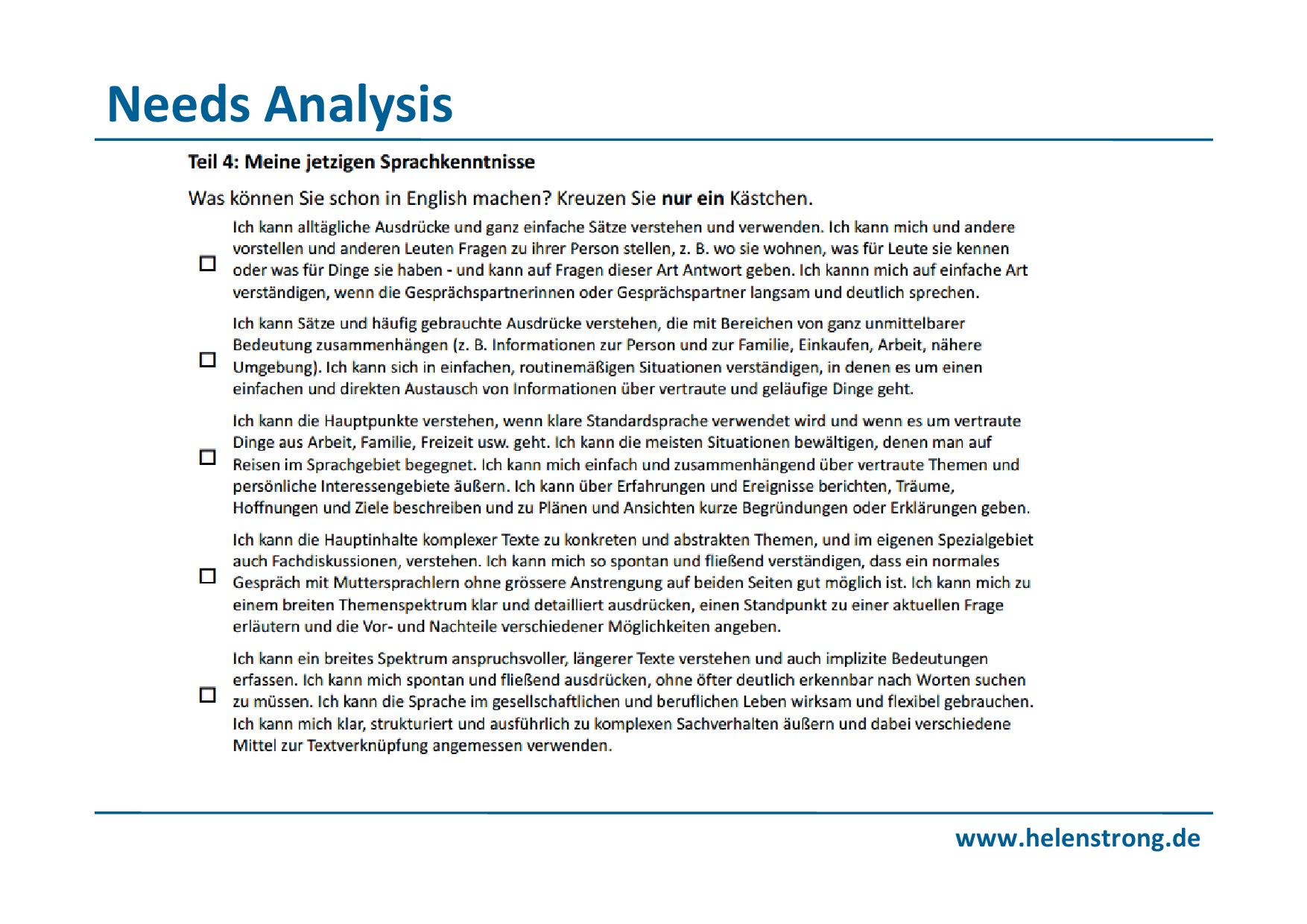
The next section was about the importance of a needs analysis. Helen’s opinion was that this is a critical step for a taking on a new client as a BE trainer, and should be non-negotiable. We discussed the various ways you can carry out a needs analysis, including shadowing, interviews or questionnaires. I decided to test this with a potential new client of mine. I began with an interview with the department head. She was very clear that the workers needed English due to a switch in the computer systems in the company from German to English, which is happening in August. Before the workshop with Helen, this would have been enough for me to begin with. In this case, I decided to use the needs analysis form that had been provided by Helen.
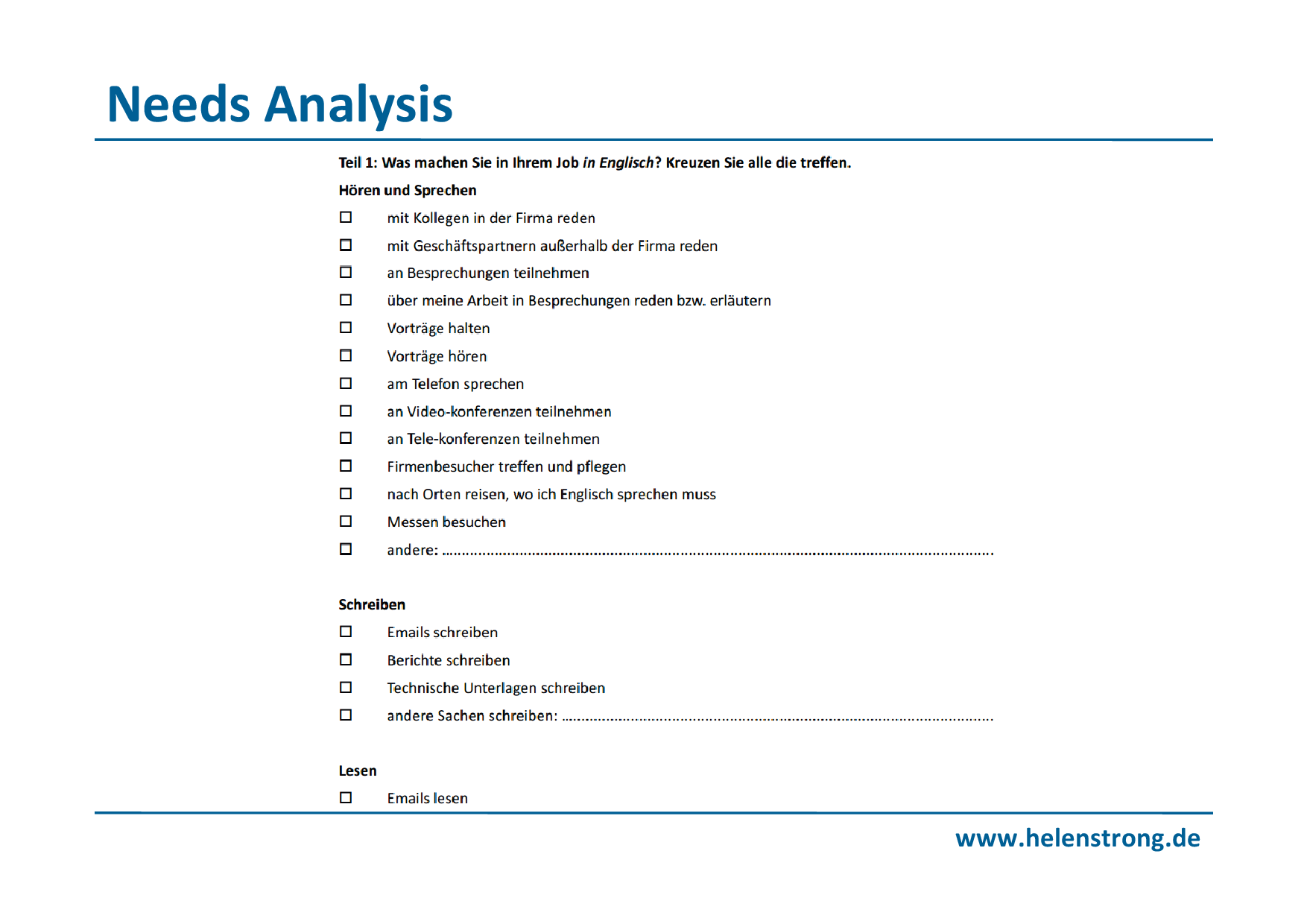
Part One looked like this
It’s a tickbox exercise covering many typical business interactions. I had twelve respondents, who I met for an individual face to face meeting, and what is interesting is that none of them mentioned computer systems, even after some gentle prodding from me. The biggest concern for nearly all of them was telephone English or speaking with English speaking colleagues. As this was different from I had initially been told, it already highlighted how useful this tool was going to be.
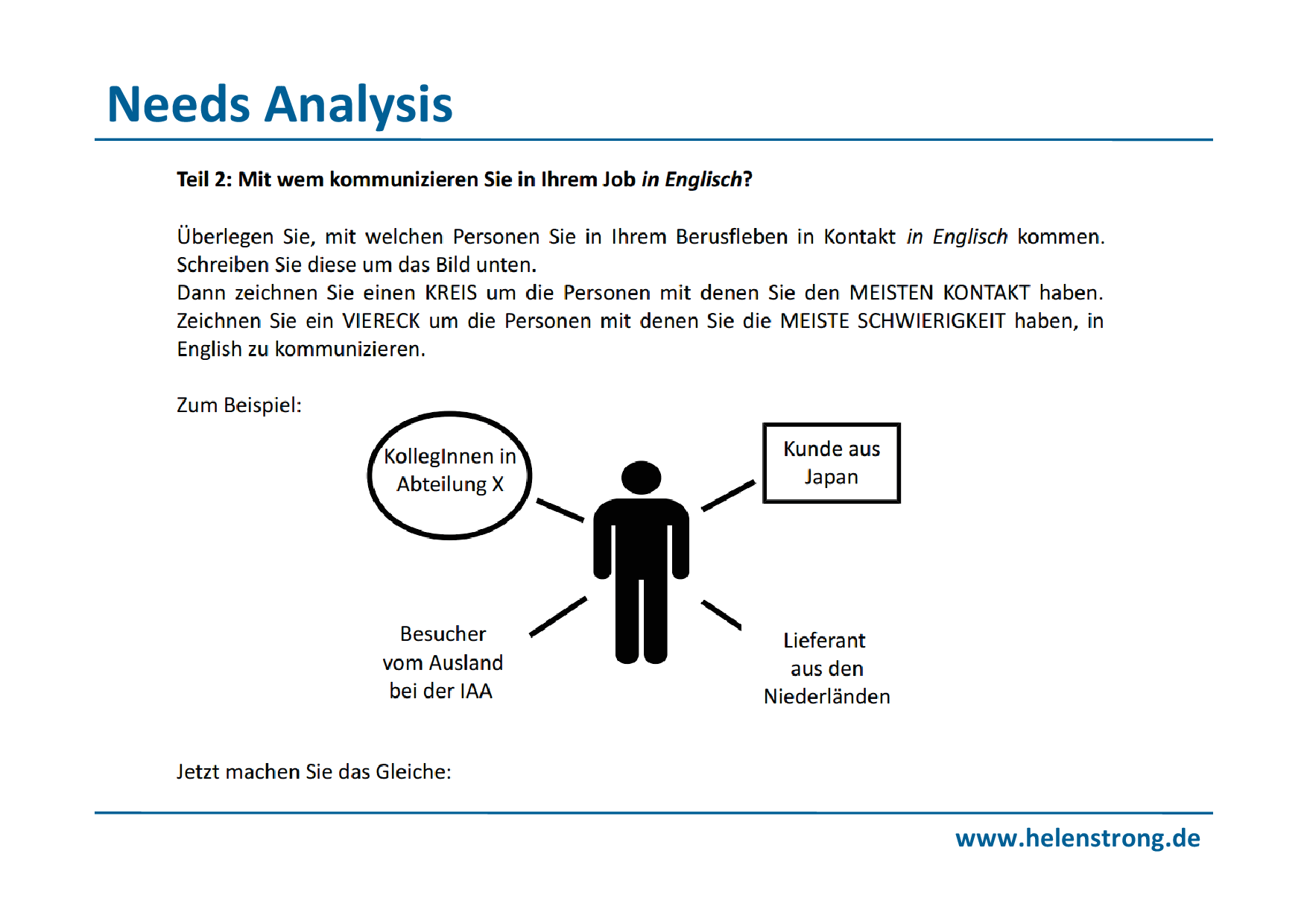
Part two caused some confusion at first, but after some explaining, and some thinking most got the gist of it. This particular cohort only only communicates with two groups of people in English: tenants and Swedish colleagues. So I didn’t get too much new information here, but I think that comes down to this particular situation. In a more varied international setting its value would increase a lot.
Part Three was particularly interesting. Again no mention of the forthcoming computer system change. However it provided a lot of topics will be used in upcoming lessons. The fact it was in German relaxed the students, although one was frustrated that she couldn’t express herself as she wanted in English. Overall I think that Helen’s advice to allow German at this stage is definitely sound advice. Different students used that permission to differing degrees, some wanting an early start to their practise, others wanting to get their reasons across in German.
The final section was a description of English language capabilities taken from the CEFR framework. I have to be honest and say I didn’t get much benefit from this, except perhaps a small psychological insight. I found students were very poor at correctly identifying their ability. Some who used English very well were marking themselves as an A1 and others who couldn’t complete a sentence in English were marking themselves as B2. Obviously, there will always be outliers but I’m not sure if I would include it in a needs analysis of my own. Overall, I found the document to be a very useful tool for a BE trainer and I am now firmly on the needs analysis bandwagon.
After all that, we had a break with a very nice spread laid on by the organisers. What I particularly liked was that Helen was very accessible here, as I had some questions that I wanted her opinion on. It was interesting to hear that networking brought in far more business for her than her website did. Which makes the next Stammtisch with ELTABB even more vital!
After the break we returned with a look at business skills starting with the six classic skills. What Helen did next which I found very interesting was transitioning these into functional skills. The business matrix that she used makes this very straightforward. The key point there sís inter… Rather than learning the six skills in solution, the suggestion is to see how these skills are usually used. I would highly recommend the use of her business skills matrix for devising training sessions when a specific purpose can be identified. Following this was a focus on culture in the workplace and a discussion of how these sometimes difficult issues could be addressed.
The penultimate segment dealt with the difference between International Business English (IBE), where at least one speaker has English as a first language, and Business English as a Lingua Franca (BELF), where none of the participant share English as a mother tongue. I found this idea very interesting, and getting the terminology made this different ideas more concrete. These particular issues and how you deal with them, are taking on increasing influence in Germany and particularly Berlin. The point being that communication and comprehension have to be the key as BE trainers. The week after I found myself saying to a student “That expression doesn’t exist in English” but when she asked me what was wrong, I had to admit there was no mistake. The sentence was grammatically and semantically sound. This prompted the workshop to pop into my head, and this reinforced my decision to change my mind with the reaction to the student. The sentence was acceptable International English, the other students, as well as me, had understood when it was spoken. What Helen Strong focused on, as I understood it, was making students aware of what barriers to communication might exist, and her argument that language is really the last piece of the puzzle when it comes to BE training seemed particularly apposite here.
The workshop finished with a description of the Cert IBET, which the workshop took a lot of information from and Helen is a provider of. The pitch was good, especially as we all know how much Germany loves certificates! As Helen said, it is something which could make a trainer stand out from the crowd, and my feeling on the day was that some attendees were interested in having her return to Berlin to provide it. I think I might be one of them, so if there are any other like minded members we should discuss it (on Ning of course!)
Overall, there was a lot of interesting point discussed, and as I’ve shown, plenty which can be put into practise. What I liked the most, that I’m definitely planning on using is the business skills matrix, and the necessity of a needs analysis is now a firmly held belief.
What about you? What did you find interesting? Was there anything you disagreed with?
Don’t forget to check out the slides from the workshop!
Every year during Pentecost weekend, Berlin residents and lots of tourists gather in Kreuzberg district for a celebration of cultural diversity. It’s a great chance to get delicious, authentic food and learn more about the people who live in this amazing city.
Berlin, the capital of Germany, is a vibrant and diverse city with a rich cultural history. One of the most significant cultural events that takes place in Berlin every year is the Carnival of Cultures. This event, which is held over the course of four days in late May, celebrates the diversity of the city’s inhabitants and their cultural heritage.
The Carnival of Cultures is a colorful and lively event that features a parade of floats, live music, and traditional dances from around the world. It is attended by thousands of people from all over Berlin and is considered to be one of the largest street festivals in Europe. The parade is led by a group of samba dancers and drummers, followed by an array of colorful floats representing different cultures and countries. The floats are decorated with traditional costumes, flags, and other cultural symbols, and they are usually accompanied by groups of dancers and musicians.
The event is not only a celebration of different cultures but also a platform for integration and learning. It is a great opportunity for visitors to learn more about different cultures, customs and traditions. The festival is also a great way to meet people from different backgrounds and to improve your language skills. The event is a great opportunity to practice your English as many visitors come from different countries. Especially when you meet people from other countries, you can learn a lot about different cultures and customs.
The festival also includes a wide range of food and drink stalls, offering a diverse selection of traditional dishes from around the world. Visitors can enjoy delicious food and drink from different cultures and countries, including African, Asian, and European cuisine.
The Carnival of Cultures is not only a celebration of the diversity of the city’s inhabitants but also a celebration of the city itself. Berlin is a city with a rich cultural heritage, and the festival is a great way to experience this heritage. The event is a great opportunity to learn more about the city and its history, as well as to enjoy the stimulating and fiery atmosphere of the city.
In conclusion, the Berlin Carnival of Cultures is a vibrant and diverse event that celebrates the cultural heritage of the city’s inhabitants. It is a great opportunity to learn more about different cultures, customs, and traditions, and also to improve your language skills. The event is a great way to experience the rich cultural heritage of Berlin and to enjoy the unique atmosphere of the city. It is a must-see event for anyone visiting Berlin and is a great opportunity to immerse yourself in the city’s vibrant and diverse culture.










 Improve your English skills