
"Empower your Communication Skills with Business English"

How can I help my career by improving my English skills?

Enrolling in a coaching program for spoken English can offer several benefits to individuals. These programs can be tailored to suit your specific needs and goals, and can help you in many ways, which we will look at here.

Improving Pronunciation

One common reason why people choose to enroll in coaching programs is to improve their pronunciation of English words and sounds. With the help of a coach, you can learn the nuances of the language and get feedback on your pronunciation.

Improving pronunciation is a crucial aspect of learning any language, and this is especially true for English. English is a language with many unique sounds and nuances, which can be difficult for non-native speakers to master. Even small differences in pronunciation can affect how well you are understood and can impact your confidence when speaking.

Enrolling in a spoken English coaching program is an excellent way to improve your pronunciation skills. A good coach can help you identify the areas where you are struggling and provide you with targeted instruction on how to improve. They can also give you feedback on your pronunciation and guide you on how to produce the correct sounds.

Improving your pronunciation skills can have a significant impact on your ability to communicate effectively in English. It can help you to be more easily understood by native speakers and make you feel more confident when speaking. Additionally, improving your pronunciation skills can also help you expand your vocabulary and improve your overall comprehension of the language.

Whether you are a beginner or an advanced learner, improving your pronunciation skills should be a top priority. With the help of a spoken English coaching program, you can achieve significant progress in a short amount of time and gain the confidence you need to communicate effectively in any situation.

Expanding Vocabulary

A coaching program can also help you learn new words and phrases, and teach you how to use them effectively in conversations. This can help you express yourself more clearly and confidently.

Expanding your vocabulary is a crucial part of becoming fluent in any language, and this is especially true for English, which has an extensive vocabulary. When you enroll in a coaching program, you’ll have the opportunity to learn new words and phrases that you may not have encountered in your everyday life. A good coach can help you understand the meaning of these words and how to use them correctly in conversations.

By expanding your vocabulary, you’ll be able to communicate your thoughts and ideas more clearly and effectively, which is essential for both personal and professional situations. In addition, having a wider vocabulary can help you understand English language media such as books, movies, and news articles, which can further improve your language skills.

A coaching program can also teach you how to use idiomatic expressions and phrasal verbs, which are common in everyday English conversations. Learning these expressions and verbs can help you sound more natural and fluent in your speech, which can lead to better communication and stronger connections with native English speakers.

Overall, expanding your vocabulary through a coaching program can help you become a more effective communicator and give you the confidence to express yourself more effectively in any situation.

Building Confidence

Learning a new language can be challenging, especially when it comes to speaking it fluently. Many people feel shy or nervous about speaking a foreign language, and this can hinder their ability to communicate effectively. A coaching program can help you overcome these obstacles and build your confidence in speaking English.

A good coach will provide a safe and supportive environment for you to practice your speaking skills. They can help you identify your strengths and weaknesses, and provide constructive feedback to help you improve. Regular practice sessions with your coach can also help you become more comfortable with speaking English in different contexts, such as in social settings or in the workplace.

As your confidence grows, you may find that you are more willing to engage in conversations in English and take more risks with your speaking. This can lead to a greater sense of satisfaction and fulfillment as you become more proficient in the language. With the help of a coaching program, you can build the confidence you need to communicate effectively in English and achieve your language goals.

Preparing for Exams

Preparing for exams such as TOEFL or IELTS can be a stressful and overwhelming experience, especially if you’re not confident in your spoken English skills. This is where a coaching program can come in handy. With a targeted approach, a coach can help you prepare for these exams by identifying your strengths and weaknesses and tailoring the instruction and practice to your specific needs.

A good coaching program will cover all aspects of the exams, from the format and structure to the types of questions you can expect. The program will also provide you with ample opportunities to practice your skills, including mock exams and feedback on your performance.

In addition, a coach can help you develop strategies to manage your time effectively during the exam and deal with stress and anxiety. By preparing thoroughly for these exams with the help of a coach, you can feel confident and ready to perform your best on test day.

Improving Professional Opportunities

In today’s globalized world, speaking fluent English is becoming increasingly important in many professional fields. Whether you’re in business, education, or healthcare, good communication skills are essential for success. By enrolling in a coaching program for spoken English, you can improve your ability to communicate effectively with clients, colleagues, and patients.

Not only can improved English skills help you perform better in your current job, but they can also open up new career opportunities. Many companies and organizations require employees to have strong English language skills, and being able to communicate effectively in English can give you a competitive edge in the job market.

Moreover, speaking fluent English can also help you build relationships with people from different countries and cultures. This can be especially important if you work in a multinational company or have clients from around the world.

A coaching program can provide you with the skills you need to succeed in your professional life. By improving your spoken English skills, you can become a more confident and effective communicator, which can ultimately lead to greater success and advancement in your career.

In conclusion, if you want to improve your spoken English skills and achieve your language goals, enrolling in a coaching program could be an effective solution. These programs can be customized to suit your needs and can help you become a more confident and effective communicator.

property manager looking at building, cartoon style, english learning

Using English as a property manager

property manager working hard to look after buildings in a cartoon style

A quick guide on English and the property management industry

As a property manager, it is essential to have excellent communication skills, and it all starts with mastering the language of communication. English has become a universal language, and using it effectively in your line of work is crucial for success. Here are some tips on how to use English as a property manager.


Master the basics

It’s important to learn basic English rules such as sentence structure, tenses, and grammar. Having a good comprehension of these basics will make it easier for you to communicate effectively with anyone.


Keep it brief and concise

When speaking or writing in English, it’s important to keep your message brief and to the point. Long-winded communication can lead to confusion and misinterpretation. So, be clear and concise in your messages.


Learn property management terminology

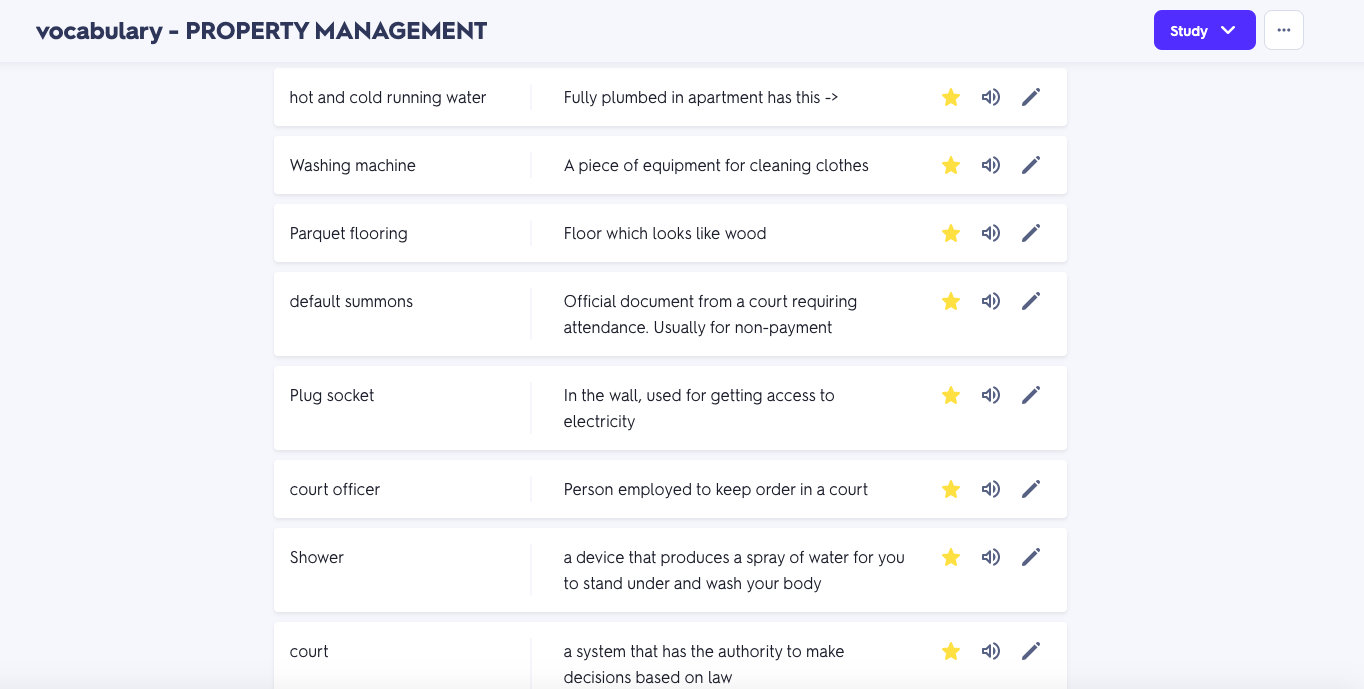
Property management has its terminology, and it’s essential to learn them. Understanding these terms will make communication easier between you and your clients, tenants, and other property management professionals. Follow the link if you want to practise

Download a pdf of property management vocabulary here


Use appropriate tone and language

It’s crucial to understand the appropriate tone and language to use in different situations. For example, formal language is more appropriate when communicating with your clients or other professionals, whereas casual language is more suitable for communicating with your tenants.


Listen actively

Communication is a two-way street, and active listening is key. Listening carefully to your clients, tenants, and other professionals will help you understand their needs and suggest effective solutions.

Mastering English as a property manager will undoubtedly make you more effective in your line of work. So, take the time to learn and use these tips to communicate effectively with all involved parties in your property management career.

As you know, managing a property can be a complex task, and it requires a range of skills and knowledge to ensure success. From tenant relations to maintenance and repairs, property management involves a variety of responsibilities. Similarly, the construction industry is a challenging and dynamic field, requiring a range of skills and knowledge to complete a project successfully. In this blog post, we will explore various topics related to property management and the construction industry, including common challenges and best practices.

About Property Management

Property management involves overseeing a property’s day-to-day operations and ensuring that it remains profitable and well-maintained. Successful property management involves various aspects, including tenant relations, maintenance, and marketing. Here are some common challenges in property management and best practices to overcome them:

  • Maintenance: One of the most common challenges in property management is maintenance. Ensuring that a property is well-maintained is essential for attracting and retaining tenants. Regular inspections can help identify any maintenance or repair needs, and prompt action can help prevent more extensive damage. Responding promptly to maintenance requests is another critical aspect of successful property management.
  • Tenant Relations: Another essential aspect of property management is tenant relations. Building positive relationships with tenants can help improve tenant satisfaction and reduce the likelihood of disputes. Addressing tenant complaints and concerns promptly and professionally can help build trust and prevent potential conflicts.
  • Lease Agreements: Lease agreements are a critical aspect of property management. Lease agreements outline the terms and conditions of the tenant’s tenancy, including rent, security deposits, and lease terms. Consistent enforcement of lease terms and conditions is important to ensure that all tenants are treated fairly.
  • Tenant Screening: Screening potential tenants is another essential aspect of property management. Thoroughly screening potential tenants before approving their application can help ensure that they are a good fit for the property and reduce the likelihood of problems down the line.
  • Property Appraisal: Property appraisal is the process of evaluating a property’s value. Property appraisals are necessary for various reasons, including determining the rental rate for the property and marketing the property to prospective tenants.

Managing a property or overseeing a project requires a range of skills and knowledge. From tenant relations to project management, there are many challenges to overcome. However, by implementing best practices and prioritizing communication and transparency, property managers can ensure success.

Test your knowledge of the property management industry

By taking our quiz and stay updated on industry news by subscribing to our newsletter.

In addition, as an English speaker, you have an advantage in the property management industry, as English is the language of business worldwide. Being proficient in English will allow you to communicate effectively with a diverse range of clients, contractors, and stakeholders. Therefore, it’s wise to invest in English language courses or materials to enhance your communication abilities and increase your marketability as a property manager.

Processing…
Success! You're on the list.


In conclusion, property management is a complex and challenging field requiring a range of skills and knowledge. However, by implementing best practices, prioritizing communication and transparency, and investing in improving your English proficiency, you can ensure success and excel in your career as a property manager. Stay tuned for more blog posts on property management and the construction industry.

How to Choose the Right Spoken English Coaching for You

If you’re looking to improve your spoken English skills, enrolling in a coaching program can be a great way to achieve your goals. However, with so many options available, it can be difficult to know where to start. This guide will help you navigate the factors to consider when choosing a spoken English coaching program, so you can make an informed decision.

Determine Your Goals and Needs.

Before choosing a spoken English coaching program, it’s important to determine your goals and needs. Are you looking to improve your pronunciation, expand your vocabulary, or gain confidence in speaking? Do you need a program that is flexible and can accommodate your schedule? Understanding your goals and needs will help you narrow down your options and choose a program that is tailored to your specific needs.

Research the Coaching Options Available.

The first step in choosing the right spoken English coaching for you is to research the options available. Look for coaching programs that have a good reputation and positive reviews from past students. Consider the teaching methods used, the qualifications of the instructors, and the level of support provided to students. It’s also important to consider the cost and whether the program fits within your budget. Don’t be afraid to ask for recommendations from friends or colleagues who have taken a similar course. By doing your research, you can make an informed decision and choose a coaching program that will help you achieve your goals.

Check the Qualifications and Experience of the Coaches.

When choosing a spoken English coaching program, it’s important to consider the qualifications and experience of the coaches. Look for programs that have experienced and qualified instructors who have a strong command of the English language. You may also want to consider coaches who have experience working with students from your native language background, as they may be better equipped to understand and address your specific needs. Don’t be afraid to ask for information about the coaches’ qualifications and experience before enrolling in a program. A good coaching program will be transparent about the qualifications of their instructors and will be happy to provide this information to prospective students.

Look for Reviews and Testimonials from Previous Students.

One of the best ways to gauge the effectiveness of a spoken English coaching program is to look for reviews and testimonials from previous students. These can give you valuable insights into the quality of the program and the experiences of other students. Look for reviews on the program’s website, social media pages, and other online platforms. You can also reach out to current or former students directly to ask about their experiences. Keep in mind that no program will have 100% positive reviews, but look for patterns in the feedback to get a sense of the program’s strengths and weaknesses.

Consider the Location, Schedule, and Cost of the Coaching.

When choosing a spoken English coaching program, it’s important to consider practical factors like location, schedule, and cost. Look for a program that is conveniently located and has a schedule that works for you. Consider whether you prefer in-person classes or online instruction. Additionally, compare the cost of different programs and make sure you’re getting good value for your money. Keep in mind that the most expensive program isn’t always the best, and a lower-priced program may still offer high-quality instruction.

Choosing the right spoken English coaching program can be overwhelming, but by considering your goals and needs, researching available options, checking the qualifications and experience of the coaches, looking for reviews and testimonials from previous students, and considering practical factors like location, schedule, and cost, you can make an informed decision. Remember, finding the right program for you can take time and effort, but it’s an investment in your future and your ability to communicate effectively in English.

Test your English

The hardest quiz yet…

Are you ready to test your English skills? Brace yourself for the hardest quiz yet! This quiz is not for the faint-hearted, as it includes a range of challenging questions that test your knowledge of specific grammar terminology.

If you’ve taken the earlier quizzes and passed with flying colors, then we commend you. But if you’re aiming to take it up a notch, then this quiz is for you. Your English skills will be put to the ultimate test, and only those who demonstrate exceptional mastery of the language will excel.

Prepare yourself for a wide range of questions that will challenge your understanding of English grammar. From simple sentence structures to complex clauses and parts of speech, you’ll need to be at the top of your game to ace this quiz.

We challenge you to get over 80% on this quiz. Can you handle it? Show us what you’ve got and prove your English proficiency. Good luck!

Useful Phrases for Business Emails

Free pdf download of phrases for business English emails

In the business world, email communication is essential to building relationships, closing deals, and completing tasks. But crafting a professional and effective email can be challenging, especially if English is not your first language. That’s why we have compiled a list of useful phrases to help you write better business emails.

1. Opening sentences:
– Thank you for your email
– I am writing in regards to…
– I hope you are well

2. Introducing new information:
– I would like to draw your attention to…
– As discussed…
– I am pleased to inform you…

3. Asking for information:
– Could you please provide me with…
– I would be grateful if you could…
– I was wondering if you could help me with…

4. Offering assistance:
– If you need any further information, please do not hesitate to ask.
– Please feel free to contact me if you have any questions.
– Let me know if there’s anything I can help you with.

5. Closing sentences:
– I look forward to hearing from you soon.
– Thank you for your time and consideration.
– Best regards,

We have put together a free PDF download for you to print, refer to, and use in your daily business email correspondence. These phrases will surely make your email writing experience smoother and more effective. Happy emailing!

Test your English

ESL (English as a Second Language) quizzes are a great way to test your knowledge of the English language and identify areas where you may need to improve. These quizzes are often used in language learning classrooms, online courses, and language exchange programs to help learners gauge their progress and measure their language proficiency.

To prepare for an ESL quiz, it’s important to review the materials covered in your English language course or study program. This may include grammar rules, vocabulary words, idioms, and pronunciation exercises. You can also find practice quizzes and sample tests online to help you prepare for the real thing.

In addition to reviewing the materials, it’s also helpful to practice your English language skills in real-life situations. This may include conversing with native speakers, reading English-language books or news articles, listening to English-language podcasts or videos, and writing in English.

To improve your English language skills, consider enrolling in a language learning program or working with a tutor. These resources can provide personalized guidance and feedback on your language skills and help you develop strategies for improving your language proficiency.

Test your English

Welcome to our ESL quiz! ESL (English as a Second Language) quizzes are a great way to test your knowledge of the English language and identify areas where you may need to improve. These quizzes are often used in language learning classrooms, online courses, and language exchange programs to help learners gauge their progress and measure their language proficiency.

To prepare for an ESL quiz, it’s important to review the materials covered in your English language course or study program. This may include grammar rules, vocabulary words, idioms, and pronunciation exercises. You can also find practice quizzes and sample tests online to help you prepare for the real thing.

Try these multiple choice questions

This quiz is designed to test your knowledge of the English language and help you identify areas where you may need to improve. Whether you are a beginner or an advanced learner, this quiz will challenge you with a variety of questions covering grammar, vocabulary, pronunciation, and more. So, get ready to put your skills to the test and see how much you know about the English language! Good luck!

SME climate hub committed business

The SME Climate Hub is an initiative of the We Mean Business Coalition, the Exponential Roadmap Initiative, the United Nations Race to Zero campaign and the International Chamber of Commerce. This partnership is an exercise in radical collaboration that opens the doors for SMEs to join the United Nations Race to Zero campaign — an international campaign that brings together an unprecedented coalition of real economy actors and 120 governments committed to achieve net-zero emissions by no later than 2050.

In collaboration with the Net Zero team at Oxford University, the SME Climate Hub provides tools and resources to enable SMEs to make a climate commitment, take action and measure their progress.​ It is our belief that climate action is everyone’s business.
We know that many businesses like ours are faced with the challenge of transitioning to a low-carbon economy. But we also know that SMEs are vital in driving change and will play a key role in achieving the net zero targets set by the UK government.

That’s why we’re proud to have signed up to the SME Climate Commitment, meaning we’re ready to take action to reduce emissions, develop green energy initiatives and engage with new green technologies.

The SME Climate Hub has been created to help SMEs meet the commitment.

By joining the SME Climate Hub, we’ll get access to a range of tools and resources, such as:

-A way to measure, track and report our carbon emissions
– Advice on setting targets
– Access to green energy initiatives
– Monthly webinars from experts on relevant concepts
– A forum to support discussion, problem-solving, and collaborative action

We’re confident that through tools such as these we’ll achieve our net zero goals and contribute to helping the EU become as climate-friendly as possible

We’re proud to have made the SME Climate Commitment. Join me and get access to a range of tools to plan how you’ll get to net zero: @SMEClimateHub 

Home – SME Climate Hub

How to speak English fluently

Practice regularly:

The more you practice, the more comfortable you will become with the language. Try to speak English as much as possible, whether it’s with native speakers or other learners.

Improve your vocabulary:

The more words you know, the more easily you will be able to express yourself. Try reading books, watching movies, or listening to podcasts in English to expose yourself to new words and phrases.

Immerse yourself in the language:

Surround yourself with English as much as possible. Listen to music, watch TV shows and movies, and try to find opportunities to speak with fluent speakers.

Be patient:

Learning a new language takes time and effort, so be patient with yourself and don’t get discouraged. With practice and dedication, you can become more fluent in English.

Listen to fluent or native level speakers:

Pay attention to how they use the language, including their intonation, stress, and rhythm. This will help you develop a better sense of how the language sounds and how to use it more naturally.

Find a language exchange partner:

Practice speaking with someone who is learning your native language. This will give you the opportunity to speak English in a low-pressure setting and receive feedback on your pronunciation and grammar.

Take an English course:

Consider taking a online English course with Shaun Trezise. This will provide you with structured lessons and feedback from a teacher who offers a personalized approach to cater to each student’s unique learning style and needs.

Use English as much as possible:

Try to use English as much as possible in your daily life. This could include setting your phone and computer to English, listening to English-language music, or joining an English-language club or group.

Don’t be afraid to make mistakes:

It’s natural to make mistakes when learning a new language, so don’t be afraid to try new things and make errors. The more you practice, the more comfortable you will become with speaking English.

Any questions? Comment below or contact me shaun@learnenglishinberlin.com

Email Us