From Newcomer to CEO: A Guide for Immigrant Entrepreneurs


Image via Freepik

Embarking on a business venture in a new country offers unique challenges and rewards for immigrant entrepreneurs. To succeed, it’s essential to grasp the nuances of the local market, harness existing resources, and cultivate a robust network. This English Online Training guide delivers key strategies for immigrant entrepreneurs aiming to launch a business locally. By addressing specific challenges and opportunities, it helps lay the foundation for a prosperous entrepreneurial journey.

Finding Opportunities in the Local Market

Start by profoundly analyzing your local community to pinpoint market gaps. Engage directly with residents through surveys or casual conversations to gauge their needs and interests. Keep an eye on trends and demands that current businesses need to meet. Use your unique skills and background to effectively devise a solution that addresses these unmet needs.

Crafting a Tailored Business Plan

Developing a detailed business plan tailored to your local market is crucial. Your plan should encompass a thorough market analysis, clear objectives, and robust strategies for achieving these goals. It should also include market-specific data and realistic financial projections to adapt to the dynamic local economy. A well-prepared business plan is your roadmap to operational success and is instrumental in securing local financing.

Digitizing Important Business Documents

Digitizing important business documents streamlines operations and boosts security and accessibility. With a mobile scanning app, effortlessly transform any document or image captured by your camera into a PDF. Ensure the app you choose offers features like password protection for crucial documents and file compression to optimise storage space. Use this free scanner app to efficiently manage contracts, invoices, and more, keeping your business agile and secure on the go.

Utilizing Local Resources and Incentives

Take advantage of local resources and incentives designed to support new businesses. Investigate local government and community organization offerings such as grants, loans, and tax breaks. Joining a local chamber of commerce can provide access to additional resources like workshops and networking opportunities. These resources can significantly reduce startup costs and offer valuable business guidance.

Networking with Local Entrepreneurs

Networking with local business owners is critical to understanding the entrepreneurial landscape. Participate in business events and regional gatherings to forge valuable connections. Engage with online forums and local business groups to share experiences and gain insights. These relationships can lead to partnerships, referrals, and increased business credibility.

Embracing Sustainable Business Practices

Incorporating sustainable practices can attract eco-conscious consumers and reduce operational costs. Use energy-efficient technologies, minimise waste, and opt for sustainable materials. Educate customers about your sustainability efforts and offer incentives for eco-friendly behaviours. Sustainable practices support the environment and strengthen your brand’s appeal.

Focusing on Exceptional Customer Service

Excellent customer service is a cornerstone of a successful local business. Prioritise creating a positive customer experience by training your staff to be friendly, knowledgeable, and responsive. Listen to customer feedback and make necessary improvements to meet their needs. Building a reputation for outstanding service can set your business apart from competitors.

Engaging with the Community

Active engagement with the local community is vital for establishing your business’s presence. Participate in community events, sponsor local initiatives, and collaborate with other companies. Use social media to connect with your audience, share updates, and promote events. Hosting workshops, webinars, or community gatherings at your business location can also attract customers and build loyalty. A strong community connection can drive business growth and long-term success.

As an immigrant entrepreneur, success in a local market hinges on a deep understanding of the environment, effective resource utilization, and strong community ties. Identifying gaps, crafting a tailored business strategy, and engaging meaningfully with locals are crucial. Emphasise sustainable operations, superior customer service, and the digital management of business documents to optimise efficiency. These strategies guarantee not only the growth of your business but also its long-term viability and integration into the community.

If you enjoyed this article, you can find more helpful content at EnglishOnline.Training!

Thrive as an Immigrant Entrepreneur

A man with a beard smiling at the camera in an indoor setting, possibly an airport or public transport area, with seating and an escalator in the background, conveys a sense of business-like professionalism

Image via Freepik

Mastering Challenges for Success

Starting your business as an immigrant presents a path filled with challenges, but also rich with rewards. The journey to entrepreneurial success is unique, with its own set of obstacles, yet your resilience and ingenuity equip you to conquer them. This guide from English Online Training is crafted to provide you with practical advice for navigating the business world. It aims to help you turn your vision into a successful, flourishing enterprise.

Simplifying Contractual Processes

The task of drafting and managing contracts can seem daunting. However, there are online tools that let you fill out and sign PDF contracts with ease, streamlining this process significantly. These tools facilitate a more efficient management of legal documents, enabling you to focus on core business activities. By leveraging these digital solutions, you can handle contracts confidently, ensuring clarity and precision in your business dealings. For instance, this tool allows for adding an e-signature for online forms, facilitating better communication while also making it easier to keep your records updated and digitally preserved.

Market Research Mastery

Understanding your market is key to business success. Conducting thorough market research helps you grasp consumer preferences and demands, tailoring your offerings to meet their needs. This knowledge empowers you to make informed decisions, positioning your products or services effectively within the marketplace. Grasping the nuances of your target audience is essential in creating a sustainable and profitable business model.

Establishing Trust and Credibility

For immigrant entrepreneurs, building credibility is a vital step towards long-term success. Establishing trust with customers, suppliers, and partners requires consistent effort and integrity. By delivering quality products and services, engaging transparently, and honoring commitments, you create a reputation of reliability. This trust is the foundation for lasting business relationships and growth.

Leveraging Local Support Networks

Don’t overlook the power of local support services and business networks. These platforms provide access to resources, mentorship, and networking opportunities, crucial for your business growth. Engaging with these communities offers insights into local market dynamics and connects you with other entrepreneurs, potentially leading to collaborations and partnerships that can propel your business forward.

Digital Marketing for Wider Reach

In today’s digital age, effective online marketing strategies are indispensable. As an immigrant entrepreneur, harnessing digital marketing tools can significantly expand your reach and enhance your online visibility. From social media marketing to search engine optimization, these strategies help you connect with a broader audience, driving traffic and increasing engagement with your brand.

Learning from Setbacks

In your entrepreneurial journey, setbacks are inevitable. Rather than seeing failures as defeats, consider them valuable lessons for learning and growth. When you embrace these experiences, they contribute to developing your resilience, adaptability, and wisdom. Each challenge you face serves as a crucial stepping stone, enhancing your skills and guiding you toward greater success.

As an immigrant entrepreneur, it’s imperative to understand the legal intricacies of your new business environment. Consulting with a business attorney equips you with crucial insights on staying compliant and managing risks effectively. They can help you decipher complex regulations, ensuring your business operates within legal boundaries, thus safeguarding your venture from potential legal pitfalls.

As an immigrant entrepreneur, your potential for success is significant, even in the face of numerous challenges. Adopting strategies like embracing digital marketing, and simplifying contracts is key to turning your entrepreneurial aspirations into a prosperous business. Your journey encompasses more than just surmounting hurdles; it’s about creating a lasting legacy of success and innovation. This path leads not only to personal achievement but also to making a meaningful impact in the world of business.

English Online Training is here to help you improve your English. Click here to book a lesson.

Thriving Across Borders: Strategies for Immigrant Business Owners

one east asian woman and one black man smiling at the camera with their arms crossed
Image via Freepik

As you embark on your entrepreneurial journey in a new country, you’ll encounter a mix of exhilaration and hurdles. Your unique position as an immigrant equips you to transform your aspirations into reality. 

This guide, courtesy of English Online Training, provides you with crucial tips to serve as your compass as you navigate the complex landscape. It aims to lead you toward achieving prosperity as a business owner in an unfamiliar setting.

In the realm of entrepreneurship, legal and regulatory knowledge is power. Dive deep into the local laws concerning business operations. 

You must familiarize yourself with necessary permits, licenses, and tax obligations, ensuring your business complies with immigration-related requirements. This understanding not only safeguards you from legal pitfalls but also fortifies the legitimacy of your venture.

Streamline Document Handling

In the digital age, efficient document management is a cornerstone of successful business operations. You can convert a PDF and other document formats to maintain a streamlined, organized system. 

This approach ensures all crucial documents, from employment contracts to regulatory paperwork, are readily accessible and up-to-date. Embrace technology to keep your business documentation in check, ensuring quick retrieval and ease of management.

Cultivate Cultural Insight for Business Growth

Understanding the cultural fabric of your new business environment is invaluable. Delving into local customs, communication styles, and business etiquettes is essential. 

This cultural acumen helps in building robust relationships with clients, partners, and employees. Resonating with the local culture paves the way for a more integrated, accepted, and successful business.

Choose the Optimal Business Structure

Deciding on the correct business entity is crucial. The benefits of forming an LLC include limited liability, tax advantages, less paperwork, and flexibility.

You can avoid hefty lawyer fees by filing yourself or using a formation service. Your business structure impacts your financial protection, tax obligations, and operational fluidity, so choose wisely to set a solid foundation for your business.

Enhance Communication Skills

Effective communication is crucial for networking and customer interactions. As an immigrant entrepreneur, refining your language skills is not just about fluency but also about understanding nuances and colloquialisms that aid in forging stronger connections. 

Enhanced communication skills open doors to new opportunities, fostering trust and rapport in your business dealings. Connect with resources like English Online Training to take your English speaking skills to the next level!

Expand Your Network

Networking is the lifeline of entrepreneurial success. Engage in industry events, business meetups, and networking sessions. These interactions are invaluable for gaining insights, seeking advice, and opening doors to new opportunities. A strong network is a source of support, resources, and potential partnerships — all of which are vital for business growth and sustainability.

Embrace Adaptability

Flexibility in business is a sign of strength, not weakness. Your ability to adapt your business model in response to market feedback and dynamics is key to long-term success. 

This adaptability ensures you remain relevant and competitive, even as markets evolve. Keep in mind the most successful businesses are those that can pivot and grow with changing times.

Focus on Customer-Centricity

Customer satisfaction is pivotal for building a robust business reputation; more specifically, delivering exceptional products and services is key. Responsiveness to customer feedback is essential in fostering a customer-centric culture. Such an approach guarantees customer loyalty and positive referrals, crucial for the enduring success of your enterprise.

Final Thoughts

Launching a business as an immigrant is a journey filled with unique challenges and rewarding opportunities. By embracing these strategies, you position yourself to overcome obstacles and capitalize on opportunities. 

Your entrepreneurial venture has the potential to thrive and contribute positively to the community you now call home. Remember that success in business — especially in a new land — is a testament to your resilience, adaptability, and commitment to excellence.

Have you embarked on an entrepreneurial journey in a new country? What strategies do you find most valuable for overcoming challenges and capitalizing on opportunities as an immigrant business owner? Share your insights with us!

A review of “How to teach business English: tips and techniques for developing yourself as a BE trainer with Helen Strong”

It was a beautiful summer day when we made our way down to Potsdam to hear Helen Strong give her workshop on “How to teach business English”. Despite the best efforts of Deutsche Bahn, it was a great turnout with around 30 teachers, trainers, language school owners and other miscellaneous ELTABB members attending down at the University of Potsdam. Helen herself had driven up from Ingolstadt the night before on her motorbike, so presumably was spared all public transport related dilemmas.


What I want to do in this review is describe the ideas that Helen put forward and also provide feedback of how it went when I put them into practise. On the day, we started off with speed networking; the classroom was rearranged into four rows of chairs, facing each other in two lines, with 3 questions provided by Helen, and three minutes to get the answer from the person opposite before the bell rang and we moved on to the next person. I really like it as an icebreaker; I ended up talking to ELTABB members that I had never spoken to before and what I especially like was that when the activity ended, Helen left us there in our new positions. It meant I went from my teacher’s pet position on the front row, right to the back row but it also meant I got out of my comfort zone of interacting with people that i already knew well. This is always a good thing!


I tried this out with two classes after the workshop and both times it was a success. The first group was actually a beginners group, and it still worked well. I asked them what they wanted to know when they met new people and we crowd sourced the questions. I also did with an intermediate group with some randomly chosen conversation questions. What I learned here was that I really needed a bell like Helen has. As she said it is important to explain the task beforehand, and I think the repetition aspect that is inherent in it really helps get learners going in a lesson.


The next discussion was about the difference between teachers and trainers. I don’t think it’s controversial to say there is a huge difference between teaching 30 school children and a 1-on-1 session with a business person. The way English language professionals approach this is still up for debate. The main point I took away from this was how we as workers shouldn’t undersell our knowledge and abilities, and also that it’s important that we are clear what they are for each of us.


The next section was about the importance of a needs analysis. Helen’s opinion was that this is a critical step for a taking on a new client as a BE trainer, and should be non-negotiable. We discussed the various ways you can carry out a needs analysis, including shadowing, interviews or questionnaires. I decided to test this with a potential new client of mine. I began with an interview with the department head. She was very clear that the workers needed English due to a switch in the computer systems in the company from German to English, which is happening in August. Before the workshop with Helen, this would have been enough for me to begin with. In this case, I decided to use the needs analysis form that had been provided by Helen.

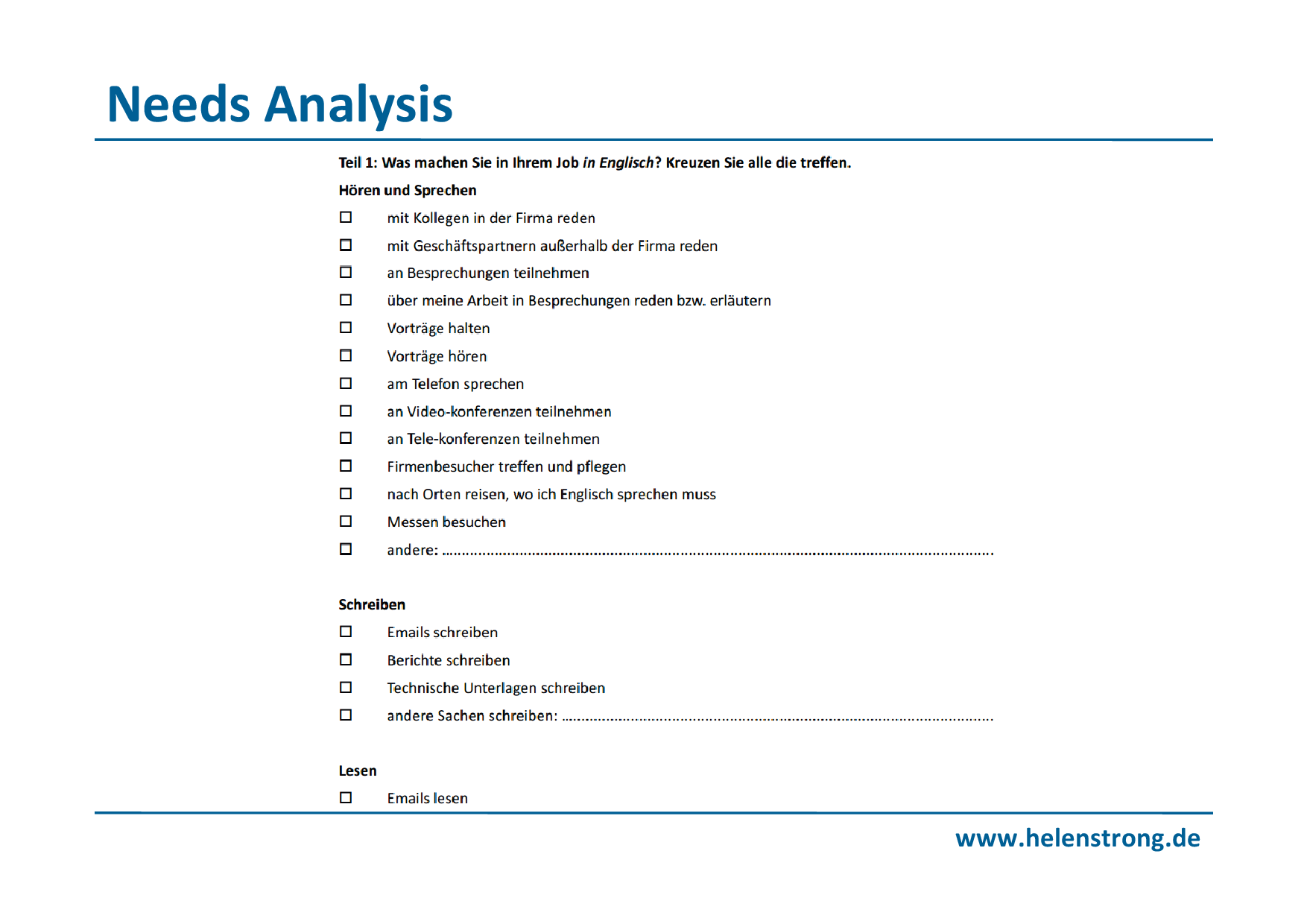
Part One looked like this

Teil 1

It’s a tickbox exercise covering many typical business interactions. I had twelve respondents, who I met for an individual face to face meeting, and what is interesting is that none of them mentioned computer systems, even after some gentle prodding from me. The biggest concern for nearly all of them was telephone English or speaking with English speaking colleagues. As this was different from I had initially been told, it already highlighted how useful this tool was going to be.


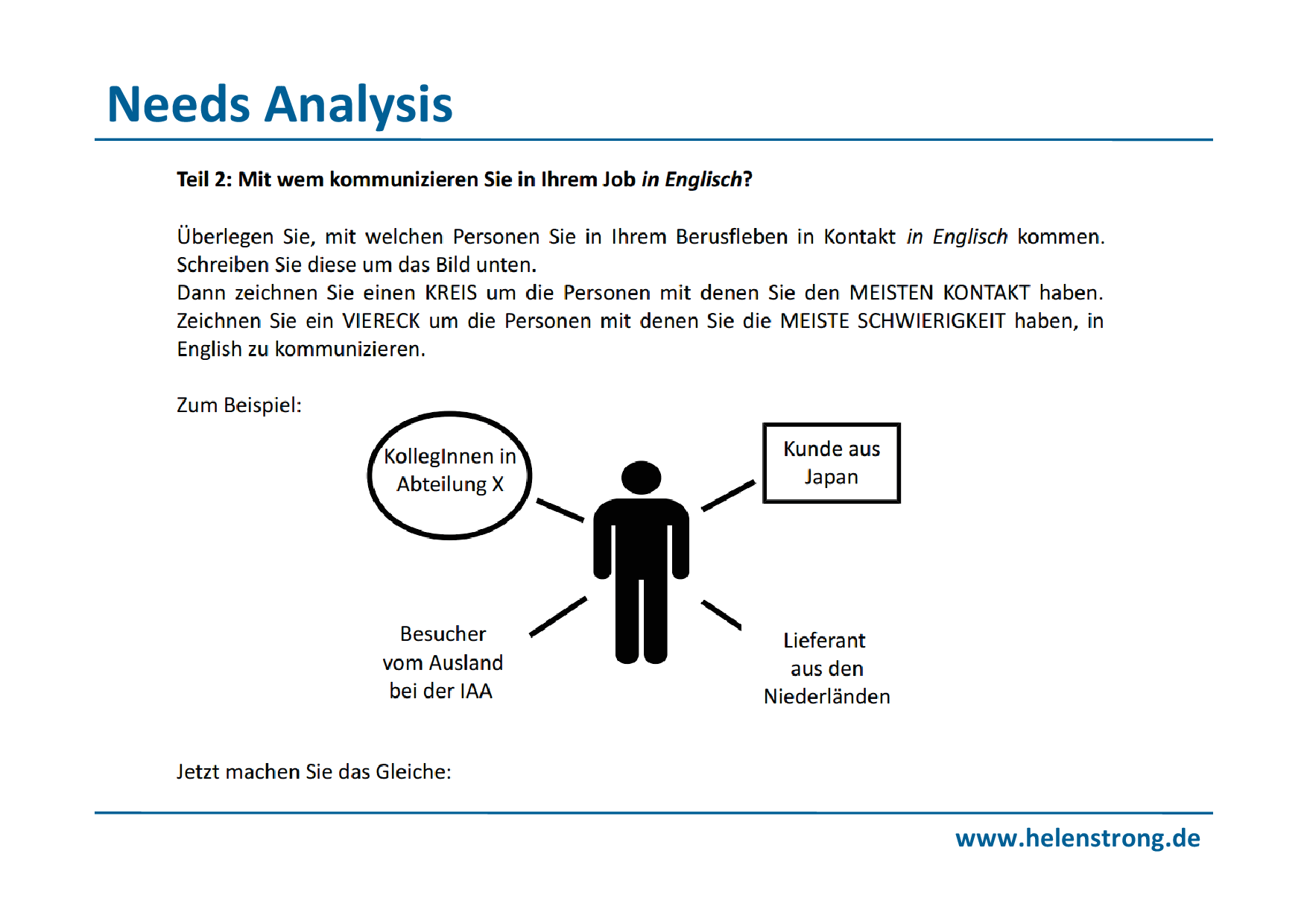
Part two caused some confusion at first, but after some explaining, and some thinking most got the gist of it. This particular cohort only only communicates with two groups of people in English: tenants and Swedish colleagues. So I didn’t get too much new information here, but I think that comes down to this particular situation. In a more varied international setting its value would increase a lot.

Teil 2

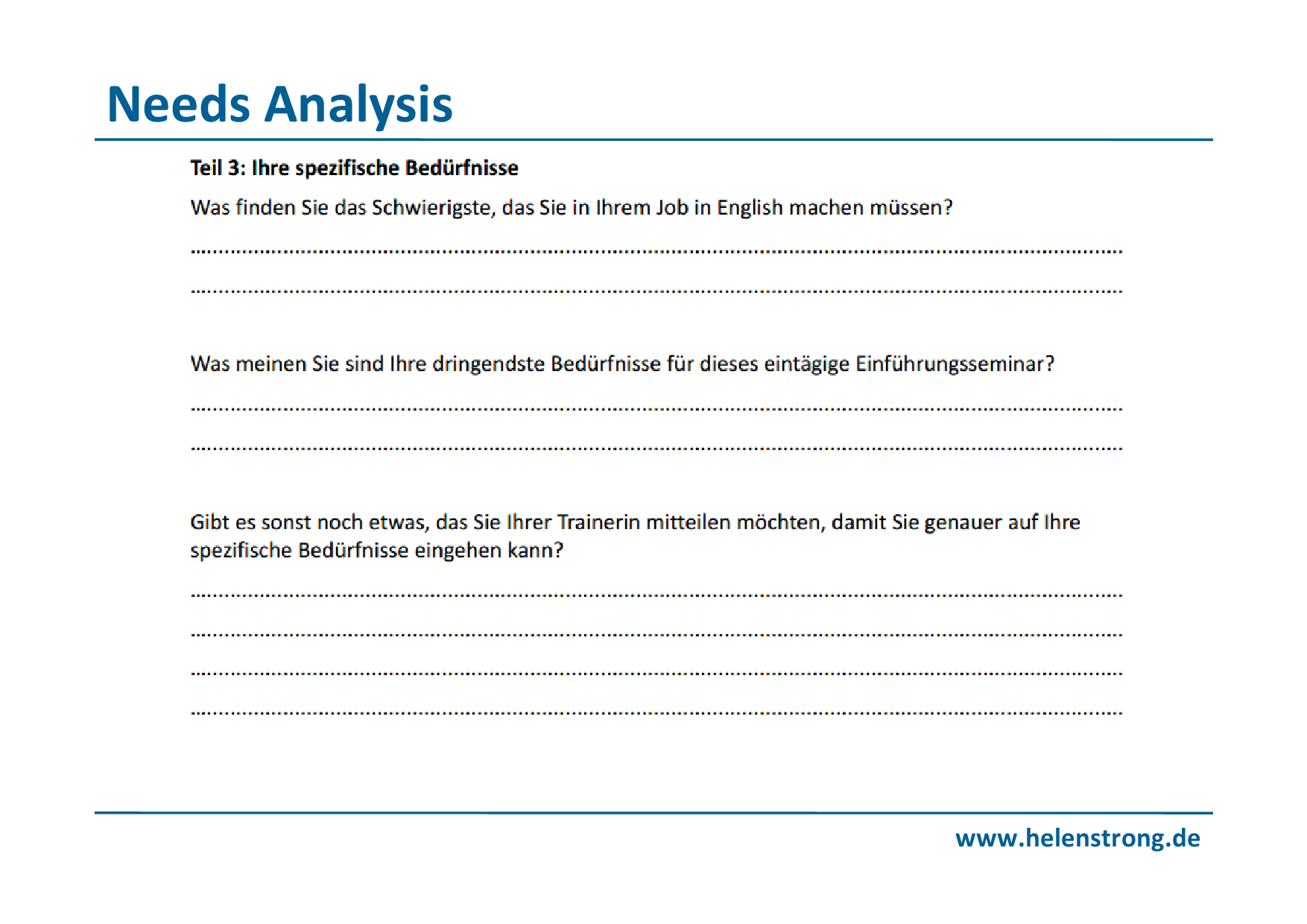
Part Three was particularly interesting. Again no mention of the forthcoming computer system change. However it provided a lot of topics will be used in upcoming lessons. The fact it was in German relaxed the students, although one was frustrated that she couldn’t express herself as she wanted in English. Overall I think that Helen’s advice to allow German at this stage is definitely sound advice. Different students used that permission to differing degrees, some wanting an early start to their practise, others wanting to get their reasons across in German.

teil 3.png

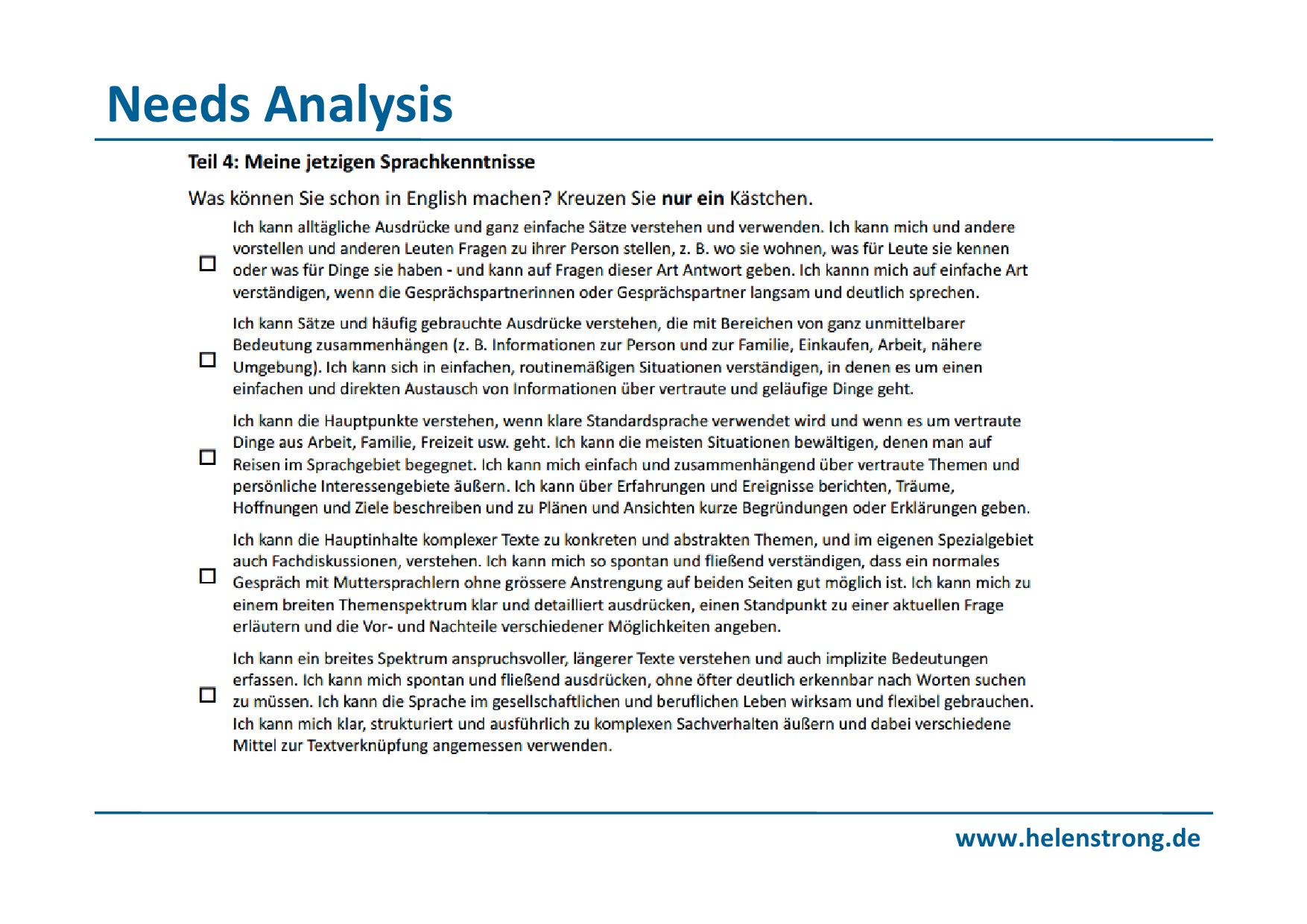
The final section was a description of English language capabilities taken from the CEFR framework. I have to be honest and say I didn’t get much benefit from this, except perhaps a small psychological insight. I found students were very poor at correctly identifying their ability. Some who used English very well were marking themselves as an A1 and others who couldn’t complete a sentence in English were marking themselves as B2. Obviously, there will always be outliers but I’m not sure if I would include it in a needs analysis of my own. Overall, I found the document to be a very useful tool for a BE trainer and I am now firmly on the needs analysis bandwagon.

teil 4.png

After all that, we had a break with a very nice spread laid on by the organisers. What I particularly liked was that Helen was very accessible here, as I had some questions that I wanted her opinion on. It was interesting to hear that networking brought in far more business for her than her website did. Which makes the next Stammtisch with ELTABB even more vital!


After the break we returned with a look at business skills starting with the six classic skills. What Helen did next which I found very interesting was transitioning these into functional skills. The business matrix that she used makes this very straightforward. The key point there sís inter… Rather than learning the six skills in solution, the suggestion is to see how these skills are usually used. I would highly recommend the use of her business skills matrix for devising training sessions when a specific purpose can be identified. Following this was a focus on culture in the workplace and a discussion of how these sometimes difficult issues could be addressed.


The penultimate segment dealt with the difference between International Business English (IBE), where at least one speaker has English as a first language, and Business English as a Lingua Franca (BELF), where none of the participant share English as a mother tongue. I found this idea very interesting, and getting the terminology made this different ideas more concrete. These particular issues and how you deal with them, are taking on increasing influence in Germany and particularly Berlin. The point being that communication and comprehension have to be the key as BE trainers. The week after I found myself saying to a student “That expression doesn’t exist in English” but when she asked me what was wrong, I had to admit there was no mistake. The sentence was grammatically and semantically sound. This prompted the workshop to pop into my head, and this reinforced my decision to change my mind with the reaction to the student. The sentence was acceptable International English, the other students, as well as me, had understood when it was spoken. What Helen Strong focused on, as I understood it,  was making students aware of what barriers to communication might exist, and her argument that language is really the last piece of the puzzle when it comes to BE training seemed particularly apposite here.


The workshop finished with a description of the Cert IBET, which the workshop took a lot of information from and Helen is a provider of. The pitch was good, especially as we all know how much Germany loves certificates! As Helen said, it is something which could make a trainer stand out from the crowd, and my feeling on the day was that some attendees were interested in having her return to Berlin to provide it. I think I might be one of them, so if there are any other like minded members we should discuss it (on Ning of course!)

Overall, there was a lot of interesting point discussed, and as I’ve shown, plenty which can be put into practise. What I liked the most, that I’m definitely planning on using is the business skills matrix, and the necessity of a needs analysis is now a firmly held belief.

What about you? What did you find interesting? Was there anything you disagreed with?  


Don’t forget to check out the slides from the workshop!


Benefits of in-country hire

View in Berlin
View in Berlin

Good human resources management in an international company means getting the right people in the right jobs at the right time. But what is your version of right? There is no one size fits all approach to hiring that means there are no risks and what is right for other digital startups might not be right for yours. If you are thinking about what  the right way is for your company to expand into Europe please read on.

If this is your company’s first step into the relative unknown that is the European market, it’s not possible to get away from the fact that it is different from North America. There are different cultures to deal with. While an American employee may brag about the amount of hours they have worked that week or the lack of vacation days taken that year a European worker is legally entitled to paid time off and will expect to take it. And its not just holidays, there are organisational cultures which vary from U.S. to E.U. too.

Profit is not the only motivator, society as a whole is more of consideration as well and there is far more bureaucracy as a rule in European countries. Having an insider who is used to dealing with the vagaries of town officials and their requests could be invaluable.

If the main base for your company is going to stay in the U.S. then you need to have people you can trust, and who subscribe to your values, in control. It is crucial that they project your company’s principles through your expansion. You might be roughly 5 and a half thousand miles or more away and its unrealistic to be expect to be able to micromanage at that distance (and with those time zones). It might feel safer to send someone who you know, and who knows your company’s way of working. But safer isn’t always better and relocating to another continent is a big commitment. Will your go-to guy (or girl) be able to make that kind of pledge? Would you want them to? Anyone who is going to cross half the world is not going to be able to do it at the drop of a hat.

If you are looking to expand across the Atlantic, it is likely that you are also wanting to grow your network, something which is made much easier with people who have fully developed support infrastructures. If it is truly not what, but who you know, then having the right contacts can be crucial.

Also, having fresh input into your company could be invaluable for the development of your company. The different cultures mentioned earlier will result in a different world view, and fresh eyes might be able to solve a problem you didn’t even know existed. This influx could provide the innovation that turn your great idea into a game-changer. And let’s face it, you are not truly a multinational company while you are exclusively hiring American employees, albeit in “non-American” locations.

Another important factor to bear in mind is speed of delivery. If a week is a long time in politics, 6 months can be a lifetime when it comes to digital start-ups. What is hot right now can quickly become obsolete, or have its potential market wiped out by a competitor who just got to market that little quicker. Although notice periods tend to be longer in Europe (typically 3 months), this compares favorably with the time it would take to relocate the necessary American resources. Once you take into account that the EU is churning out over 2 million graduates a year,  across all fields the future suddenly looks bright when it comes to finding the right talent to help your company progress further.

Business in profile

CiteAb is fast becoming the go-to place for antibody search. And it’s part of the vibrant southwest tech scene that is making Bath and Bristol an exciting place to do business right now

The simple way to find the right antibody for your experiment

Founded in March 2013 by in as a response to repeated exasperation when trying find the correct antibodies for experiments. Dr Andrew Chalmers, senior lecturer at the University of Bath and co-founder of CiteAb had this to say about his reasons for starting CiteAb:

“My own frustration at the amount of effort students and postdocs in my lab spent looking for antibodies, and the number of antibodies we bought that didn’t work, were real drivers in developing the idea for CiteAb. The time and money wasted made me believe there must be a better way of searching for and choosing between antibodies.”

So they resolved to solve the problem and CiteAb was born. Dr. Andrew Chalmers (University of Bath) and Dave Kelly (Storm Consultancy) were the co-founders, with guidance and support provided by the University of Bath. Their aim was to to help researchers find the right antibody for their experiments – ultimately saving time and money, and helping research progress faster, By June 2013 they already had 1 million antibodies listed on their search engine (it’s now approaching 2 million with the words “Aaah – too… many… antibodies!”) The site now gives researchers access to antibodies from over 60 companies worldwide, rated by their citations in over 100,000 research papers.CiteAb also won an award for ‘best startup’ shortly after they launched, recognising the significant impact they had made in the market within a fairly short amount of time. Now they are looking at ways to ensure the long-term stability and progression of CiteAb, which is a really exciting phase of their development.

What makes CiteAb stand out from their competitors is the veracity of their search results. Unlike other antibody search engines, no company can pay to have their results top listed. CiteAb is unbiased and as Dr. Chalmers explains “The core ethos of CiteAb is that we are completely impartial – we list antibodies according to citations, so the only way an antibody can move up the ratings is to be used successfully in research and be cited by other researchers.”

Typical CiteAb users are research scientists from a range of research institutions and pharmaceutical companies who want to find antibodies that are known to work. Their clients are usually based in the pharmacy or biotechnology sector, often companies that produce and sell antibodies. They work with us to ensure their latest products are listed on CiteAb and they’re also very interested in the data we can show them that reflects the state of the market.

So what comes next for CiteAb? First they built up the data, (CiteAb is the largest citation ranked antibody search engine in the world) now comes the time to analyse it. Recently they’ve been taking a more in depth look at the wealth of publication data held within CiteAb. This has allowed them to produce a series of reports showing market share trends for countries, companies, antibodies and research areas. Unlike the usual market surveys, CiteAb’s are unique in that they’re based on analysis of hundreds of thousands of antibody specific publications, so they are able to provide a comprehensive and unbiased view of the bioscience research market. That huge database of antibody citations also provides a valuable resource to find experimental details when planning antibody experiments.

Being based in Bath has its advantages too: Dr Chalmers has a really strong network of potential CiteAb users here in the city in the University of Bath’s thriving Faculty of Science. The University provided CiteAb with a great deal of support during the initial development and spinout, and continues to be involved on the CiteAb board. Connections within the sector that can be reached through an institution like the University of Bath are invaluable to a small company in its early years. The city of Bath is also conducive to the growth of young companies – especially those with a digital or online angle. According to Matthew Helsby, the development manager at CiteAb “The city has a strong digital presence and there is a lot of support for startups and those new to business.”

That’s not to say it has been completely plain sailing. For Dr. Chalmers, who has a background in research, moving into the business world has meant a completely different way of working. The adjustment took some getting used to and although he wished he would have known that everything would take twice as long as you might expect, he has found the whole process extremely exciting. Luckily David Kelly, the other co-founder, with a background is in web software development, was there to provide support on the business and software side although he said “just learning what an antibody is” was a good first step for him.

Although not currently looking for investors or employees, as they are quite a young startup, CiteAb believe with the future looking as bright as it does that hopefully they will do soon. Opportunities are first posted on their blog so it’s worth keeping an eye on that and they are always keen to hear from people who are interested in CiteAb, so if you’ve any questions please do give them a shout, as “we love to talk about our organisation!”

Additional Info: blog and social media (LinkedIn/Twitter/Facebook/Google+)

Tech blogs – Eastern Europe

berlin
berlin

Over the past 5-10 years, the Central and Eastern European region (CEE) has been quietly building a reputation as a potential competitor to India in the tech outsourcing business. Now signs are pointing to the region being the next global tech start up hub.

For companies with a European base of operations, the advantages of outsourcing to CEE are clear. There is a low cost, (salaries are typically 50% lower than western Europe) highly educated, skilled workforce (Poland ranks above the U.S.A and Germany on the Pearson plc Global Index of Cognitive Skills and Educational Attainment of 39 developed nations in 14th place). Plus there are minimal cultural differences, combined with the fact they are located in the same or neighbouring time zones. Also, important if you are working in a data sensitive industry, for CEE countries in the E.U. the same data protection laws are applied. These ideal outsourcing conditions have led to companies such as  Google, IBM, Samsung, HP, Microsoft, Nokia-Siemens, SAP, HSBC, Xerox, Fujitsu, Symantec, General Electric and many more making use of C.E.E. as an a near-shoring opportunity, with Poland in particular being seen as a outsourcing hub. Capgemini, which provides business and computer outsourcing for almost 100 corporations, including Coca-Cola and Volkswagen operates five centers in Poland.

There are some disadvantages, with most of the outsourcing companies of a much smaller scale than their south Asian rivals. This means they can’t compete directly in cost per capita, and if you have large scale, exact brief that doesn’t need too much supply-side innovation then India may still be the best location to outsource to. However, the CEE countries are able to turn this small size to their advantage, as they are much more able to do innovative, experimental projects with much less direct management than is needed for Indian projects.

So, with so much skilled labour (Romania has an estimated 64,000 I.T. specialists alone) and hundreds of thousands of tech aware, motivated, potential entrepreneurs graduating each year, this has been a period of real growth across the region. This on its own isn’t enough to create a viable tech eco-system, but the thing that is making the real difference is cash. After all, these areas have for a long time had talented, hardworking people. What has changed is huge amounts of capital invested in the area with billions of Euros being pumped into Poland, Czech Republic, Slovakia etc to improve their infrastructure and also provide grants to promote entrepreneurship. But it’s not just government money, increased amounts of angel investors and VC’s are increasingly targeting CEE. Over the past few years several startup success stories have emerged across CEE.  These include AVG and Avast from the Czech Republic, Nordeus from Serbia, Filestube from Poland, BitDefender and Soft32 from Romania, and Prezi, Indextools, LogMeIn, and Ustream from Hungary and they have attracted investors seeking scalable ideas. Many people believe that C.E.E. is 10-15 years behind western Europe for tech start ups and, now the money tap has been turned on, the region is primed for massive growth.

So what does this mean for US businesses? While the basic ingredients are there for growth, what is really needed for CEE to truly become a international tech hub is expertise in developing local success stories into global ones. The seed money is there and there are a lot of talented people working hard to grow their start ups but for every Skype there are thousands which can’t make the leap. This is of course the same with every tech hub, but with the right partnerships, and maybe a bit of US know-how, the sky is the limit for these CEE countries and the companies they work with.