Navigating Banking as an Immigrant: Essential Steps to Open a Bank Account

Image: Freepik

Opening a bank account in a new country is a pivotal step for immigrants establishing financial independence. It can seem overwhelming, but with the right preparation and information, the process can be streamlined. Engaging with community organizations can offer vital insights and help in choosing an immigrant-friendly bank. This guide simplifies the journey, ensuring you select a financial institution that best fits your unique circumstances.

Seek Guidance from Community Organizations

Many community organizations work specifically with immigrants and can offer invaluable advice on choosing the right bank. These organizations often have partnerships or insights into which banks are more immigrant friendly. Consulting with them can provide you with recommendations tailored to your unique needs, ensuring that you select a bank that understands and accommodates the challenges you may face as an immigrant.

Organize Your Financial Documents

Organizing your financial documents is crucial when setting up a new bank account. Keeping everything from identification to proof of address neatly filed, particularly in PDF format, ensures that your information is both secure and easily shareable. There are numerous online tools available to convert, compress, edit, rotate, and reorder your PDFs—give this a try to maintain an efficient and tidy document system. This proactive approach will help streamline your banking process, preventing any unnecessary delays.

Understand Bank Fees and Charges

It’s crucial to understand the fee structure of the bank you choose. Banks can have various fees, including monthly maintenance fees, transaction fees, and costs associated with sending money abroad. Being aware of these fees upfront can help you avoid unexpected charges and manage your finances better. Ask the bank to provide a detailed breakdown of all potential fees so you can compare different banks and make an informed decision.

Prioritize Convenient Locations and Customer Service

Choosing a bank with convenient locations and good customer service is essential. A bank with branches near your home or workplace can make managing your account easier. Additionally, good customer service can be a lifesaver if you encounter any issues or have questions about your account. Look for reviews or ask for recommendations to find a bank that is known for its helpful and friendly customer support.

Learn About Account Requirements

Different banks have different requirements for opening an account. These can include various forms of identification, proof of address, and possibly a minimum initial deposit. Understanding these requirements beforehand can help you prepare all necessary documents and ensure you meet all criteria. Check the bank’s website or speak to a representative to get a clear list of what you need.

Explore Banks with Immigrant-Specific Services

Some banks offer services specifically tailored for immigrants. These services can include multilingual customer support, lower fees for international transactions, or specialized accounts designed to help newcomers manage their finances. Research different banks to see if they have any programs or accounts that cater to immigrants. These specialized services can make banking more accessible and beneficial for you.

Inquire About Remittance Services

If you need to send money to family or friends abroad, it’s important to ask about remittance services and the fees associated with international transfers. Some banks offer lower fees or faster transfer times for remittances. Understanding these services can help you choose a bank that offers cost-effective and reliable international money transfers, saving you money and ensuring your loved ones receive funds promptly.

Check for Minimum Balance Requirements

Many banks have minimum balance requirements for their accounts. Failing to maintain this minimum balance can result in additional fees. Before opening an account, check what the minimum balance requirement is and ensure it’s something you can comfortably maintain. If you think you might struggle to keep the minimum balance, look for banks that offer no-minimum-balance accounts to avoid unnecessary fees.

Opening a bank account as an immigrant involves several important steps, from consulting with community organizations to understanding bank fees and requirements. By staying organized, researching your options, and asking the right questions, you can find a bank that meets your needs and helps you manage your finances effectively in your new home. Taking these steps will not only simplify your banking experience but also provide a solid foundation for your financial future.

Elevate your English skills with English Online Training. Our flexible and personalized courses are designed to help you achieve fluency and confidence in business communication.


What are conditional sentences?

Conditional sentences, also known as “if-then” sentences, express a relationship between a condition and its result. They usually consist of two clauses: the “if” clause (conditional clause) and the “main” clause (result clause). The “if” clause sets the condition, and the “main” clause presents the consequence or result of that condition.

Conditional sentences are a fundamental aspect of the English language. They serve to express hypothetical situations, possibilities, or cause-and-effect relationships. By using conditional clauses, we can explore different scenarios and their potential outcomes.

Understanding and using conditional sentences correctly can greatly enhance your ability to express different shades of meaning and convey complex ideas in English. So, remember to consider the specific conditions and their corresponding results when constructing conditional sentences.

There are several types of conditional sentences:

Zero Conditional:

This type of conditional sentence expresses general truths or facts, where the result is always true if the condition is fulfilled. It is formed using the simple present tense in both clauses. Example: If you heat water to 100 degrees Celsius, it boils.

First Conditional:

The first conditional is used for real and possible situations in the future. It is formed using the simple present tense in the “if” clause and will/can/may + base verb in the “main” clause. Example: If it rains tomorrow, we will stay indoors.

Second Conditional:

The second conditional deals with hypothetical or unlikely situations in the present or future. It is formed using the simple past tense in the “if” clause and would/could/might + base verb in the “main” clause. Example: If I had more money, I would buy a new car.

Third Conditional:

The third conditional expresses unreal situations in the past and their imagined consequences. It is formed using the past perfect tense in the “if” clause and would/could/might + have + past participle in the “main” clause. Example: If she had studied harder, she might have passed the exam.

Mixed Conditional:

Mixed conditionals combine elements of the second and third conditionals. They describe situations where the condition relates to the past, but the result relates to the present or vice versa. Example: If I had saved more money in the past, I would be wealthier now.

Test your grammar skills

ex 1. Zero conditional

(fill in the blank with the correct verb, in the correct form)

come flood boil get evacuate freeze fall dissolves grow fizz

  1. If you heat water to 100 degrees Celsius, it ________________.
  2. If the temperature drops below zero, water ________________.
  3. If plants receive enough sunlight, they ________________.
  4. If you mix red and yellow, you ________________orange.
  5. If you press the switch, the light ________________on.
  6. If the alarm rings, students ________________.
  7. If you add salt to water, it ________________.
  8. If it rains heavily, the streets ________________.
  9. If you drop a ball, it ________________.
  10. If you mix vinegar and baking soda, it ________________.

Test your grammar skills

ex 2. First conditional

(fill in the blank with the correct verb, in the correct form)

  1. If you study hard, you ________________ the exam with flying colors. (pass)
  2. We will go for a walk if it ________________ outside. (not/rain)
  3. If she finishes her project on time, her boss ________________ her efforts. (appreciate)
  4. I will call you if I ________________ any updates on the situation. (get)
  5. If they don’t hurry, they ________________ the last bus home. (miss)
  6. If you save enough money, you ________________ a new car. (buy)
  7. If it snows tomorrow, schools ________________ closed. (be)
  8. She won’t be late if she ________________ a taxi to the airport. (take)
  9. If you eat healthy food, you ________________ better. (feel)
  10. If you don’t finish the report in time, your manager ________________ disappointed. (be)

Test your grammar skills

ex 3. Second conditional

(fill in the blank with the correct verb, in the correct form)

  • If I were you, I ________________ for that job opportunity. (apply)
  • If she had more time, she ________________ a trip around the world. (take)
  • I would be surprised if he ________________ to the party. (come)
  • If they won the lottery, they ________________ a new house. (buy)
  • If it weren’t so expensive, I ________________ that designer dress. (buy)
  • She would feel better if she ________________ some rest. (get)
  • If he were taller, he ________________ a basketball player. (be)
  • If we had more resources, we ________________ a bigger project. (start)
  • If you were more careful, you ________________ mistakes. (make)
  • If I had a map, I ________________ lost. (not/get)

Test your grammar skills

ex 4. Third conditional

(fill in the blank with the correct verb, in the correct form)

  1. If she had studied harder, she ____ the exam. (pass)
  2. If they had taken the earlier flight, they ____ in time for the meeting. (arrive)
  3. He wouldn’t have missed the train if he ____ his alarm. (set)
  4. If we had known about the traffic jam, we ____ a different route. (take)
  5. She wouldn’t have been late if she ____ up earlier. (get)
  6. If they had practiced more, they ____ the competition. (win)
  7. He would have understood the instructions if he ____ them carefully. (read)
  8. If I had known about the party, I ____ it. (attend)
  9. If she hadn’t missed her flight, she ____ at the conference. (speak)
  10. If they had studied Spanish, they ____ the language. (learn)

Test your grammar skills

ex 5. Mixed conditional

(fill in the blank with the correct verb, in the correct form)

  1. If I had more experience, I ________________ for that job. (apply)
  2. If she understood the instructions, she ________________ mistakes. (not/make)
  3. He would feel happier if he ________________ more time with his family. (spend)
  4. If we had saved enough money, we ________________ on a vacation. (go)
  5. If they had seen the movie, they ________________ how it ends. (know)
  6. She would be healthier if she ________________ better eating habits. (have)
  7. If he were more organized, he ________________ all his tasks on time. (complete)
  8. If we had known about the event, we ________________ it. (attend)
  9. She wouldn’t be stressed if she ________________ some time off. (take)
  10. If they had made better decisions, they ________________ the consequences. (avoid)

Test your grammar skills

ex 6. Conditional sentences

(fill in the blank with the correct verb, in the correct form)

  1. If you bring the ingredients, I ________________ the cake for the party. (bake)
  2. We would have arrived on time if we ________________ the shortcut. (take)
  3. If he were here, he ________________ you exactly what to do. (tell)
  4. If they find the address, they ________________ the party location. (inform)
  5. If I had known about the meeting, I ________________ my schedule accordingly. (arrange)
  6. If you water the plants regularly, they ________________ healthy and vibrant. (remain)
  7. If she could play the guitar, she ________________ us a song. (perform)
  8. If you had called earlier, I ________________ my plans. (change)
  9. Would you mind if I ________________ a look at your notes? (take)
  10. If the weather were better, we ________________ for a hike in the mountains. (go)

Test your Business English grammar skills

ex. 7 Conditional sentences

(fill in the blank with the correct verb, in the correct form)

Be Increase Sign Improve Choose Make Reward Be Cut Adjust

  1. If we deliver the project on time, the client ________________ satisfied.
  2. If the marketing campaign is successful, sales ________________.
  3. If the team meets its targets, the company ________________ them.
  4. If we invest in employee training, productivity ________________.
  5. If we offer competitive prices, customers ________________us.
  6. If the negotiation goes well, we ________________the contract.
  7. If the market conditions change, we ________________our strategy.
  8. If we implement cost-saving measures, the company ________________ expenses.
  9. If the team collaborates effectively, the project ________________ successful.
  10. If we analyze the data thoroughly, we ________________ informed decisions.

Test your Advanced Business English grammar

ex 8. Conditional sentences

(fill in the blank with the correct verb, in the correct form)

(will/adjust)(may/widen)(shall/increase) (could/boost) (might/pursue)(can/unlock)(shall/attract)(must/seek)(may/require)(will/reduce)

  1. If the company diversifies its product line, it ________________ its market share.
  2. If we incorporate AI technology, we ________________ operational efficiency.
  3. Should the negotiations break down, we ________________ an alternative solution.
  4. If we leverage our network effectively, we ________________ new business opportunities.
  5. If the management implements the cost-cutting strategy, we ________________ profitability.
  6. Should the demand exceed supply, we ________________ the prices.
  7. If the marketing team executes the campaign successfully, we ________________ a new customer base.
  8. Should we encounter legal challenges, we ________________ professional counsel.
  9. If the project timeline accelerates, we ________________ additional resources.
  10. If we optimize our supply chain, we ________________ production costs.

Conditional sentences using advanced Business English verbs:

ex 9. Advanced conditionals

(fill in the blank with the correct verb, in the correct form)

(could/incur)(shall/receive)(will/activate) (may/attain)(can/anticipate)(may/abandon)(must/implement)(will/adjust)(could/establish) (shall/achieve)

  1. If the company fails to meet regulatory requirements, we ________________ serious penalties.
  2. Should the merger proceed as planned, we ________________ a dominant market position.
  3. If the sales team surpasses its targets, they ________________ lucrative bonuses.
  4. Should the market conditions remain stable, we ________________ substantial growth.
  5. If the project encounters delays, we ________________ our contingency plan.
  6. If the negotiations collapse, we ________________ the deal altogether.
  7. Should the economy experience a downturn, we ________________ cost-saving measures.
  8. If we secure the contract, we ________________ a long-term partnership.
  9. If the company invests in research and development, we ________________ innovative solutions.
  10. Should the market demand shift, we ________________ our product offerings accordingly.

In advanced Business English, using modal verbs in conditional sentences allows for more precise expressions of possibility, probability, and necessity in various business scenarios.

Conditional sentences using advanced Business English verbs:

ex 10. Advanced conditionals

(fill in the blank with the correct verb, in the correct form)

(might/launch)(might/gain)(shall/improve)(may/obtain)(will/see)(shall/enhance)(could/cultivate)(will/pursue)(may/reduce)(can/develop)

  1. If the marketing campaign goes viral, we ________________ a significant increase in brand visibility.
  2. Should the company merge with its competitor, we ________________ a larger market share.
  3. If the new product launch is successful, we ________________ a boost in revenue.
  4. If the project team collaborates effectively, we ________________ innovative solutions to complex problems.
  5. Should the customer feedback be positive, we ________________ customer loyalty and retention.
  6. If we invest in employee training programs, we ________________ a skilled and motivated workforce.
  7. Should the supply chain be disrupted, we ________________ alternative sourcing options.
  8. If the company adopts sustainable practices, we ________________ our environmental impact.
  9. If we implement cost-cutting measures, we ________________ operational efficiency.
  10. Should the market competition intensify, we ________________ a strategic marketing campaign.

A review of “How to teach business English: tips and techniques for developing yourself as a BE trainer with Helen Strong”

It was a beautiful summer day when we made our way down to Potsdam to hear Helen Strong give her workshop on “How to teach business English”. Despite the best efforts of Deutsche Bahn, it was a great turnout with around 30 teachers, trainers, language school owners and other miscellaneous ELTABB members attending down at the University of Potsdam. Helen herself had driven up from Ingolstadt the night before on her motorbike, so presumably was spared all public transport related dilemmas.


What I want to do in this review is describe the ideas that Helen put forward and also provide feedback of how it went when I put them into practise. On the day, we started off with speed networking; the classroom was rearranged into four rows of chairs, facing each other in two lines, with 3 questions provided by Helen, and three minutes to get the answer from the person opposite before the bell rang and we moved on to the next person. I really like it as an icebreaker; I ended up talking to ELTABB members that I had never spoken to before and what I especially like was that when the activity ended, Helen left us there in our new positions. It meant I went from my teacher’s pet position on the front row, right to the back row but it also meant I got out of my comfort zone of interacting with people that i already knew well. This is always a good thing!


I tried this out with two classes after the workshop and both times it was a success. The first group was actually a beginners group, and it still worked well. I asked them what they wanted to know when they met new people and we crowd sourced the questions. I also did with an intermediate group with some randomly chosen conversation questions. What I learned here was that I really needed a bell like Helen has. As she said it is important to explain the task beforehand, and I think the repetition aspect that is inherent in it really helps get learners going in a lesson.


The next discussion was about the difference between teachers and trainers. I don’t think it’s controversial to say there is a huge difference between teaching 30 school children and a 1-on-1 session with a business person. The way English language professionals approach this is still up for debate. The main point I took away from this was how we as workers shouldn’t undersell our knowledge and abilities, and also that it’s important that we are clear what they are for each of us.


The next section was about the importance of a needs analysis. Helen’s opinion was that this is a critical step for a taking on a new client as a BE trainer, and should be non-negotiable. We discussed the various ways you can carry out a needs analysis, including shadowing, interviews or questionnaires. I decided to test this with a potential new client of mine. I began with an interview with the department head. She was very clear that the workers needed English due to a switch in the computer systems in the company from German to English, which is happening in August. Before the workshop with Helen, this would have been enough for me to begin with. In this case, I decided to use the needs analysis form that had been provided by Helen.

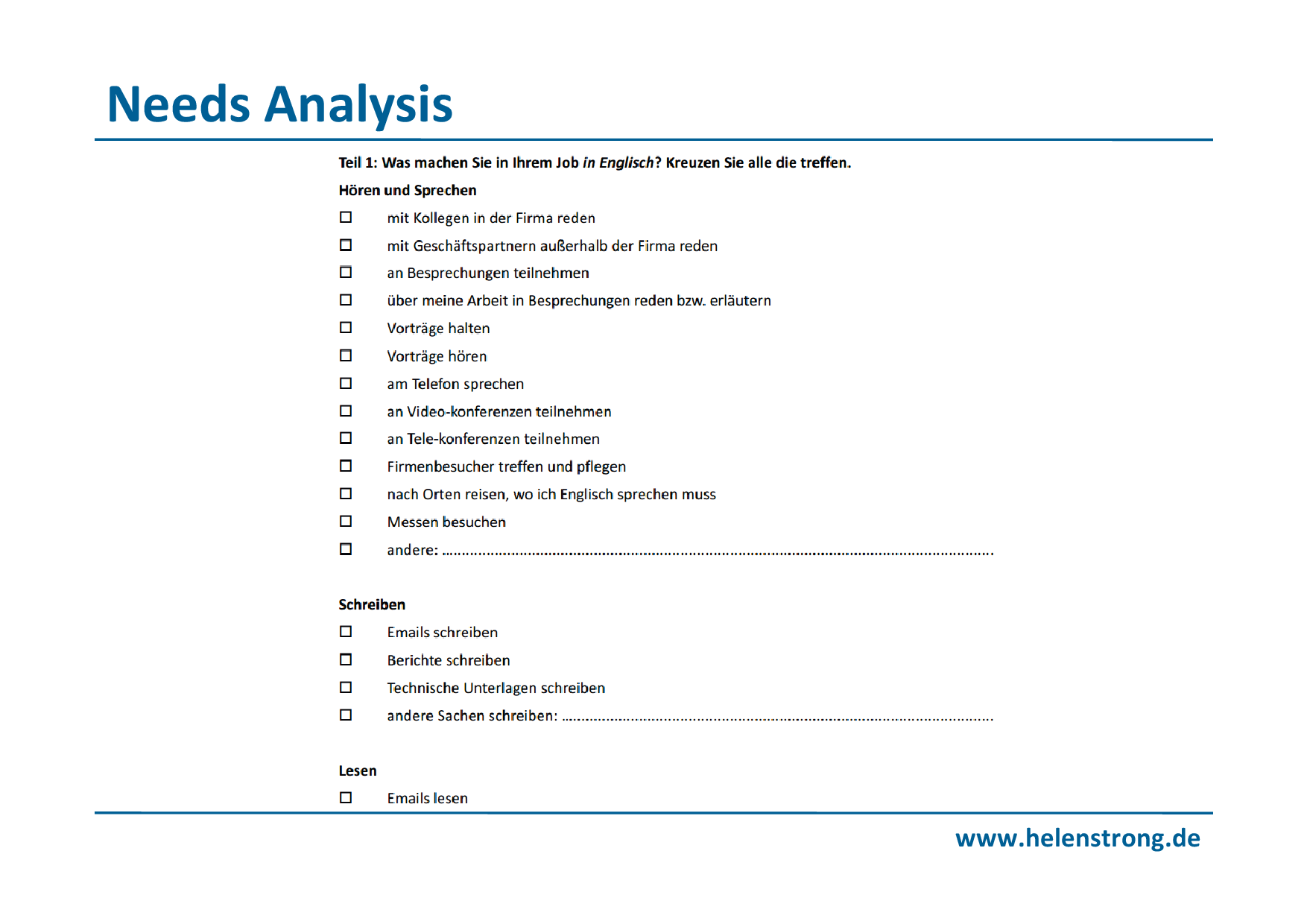
Part One looked like this

Teil 1

It’s a tickbox exercise covering many typical business interactions. I had twelve respondents, who I met for an individual face to face meeting, and what is interesting is that none of them mentioned computer systems, even after some gentle prodding from me. The biggest concern for nearly all of them was telephone English or speaking with English speaking colleagues. As this was different from I had initially been told, it already highlighted how useful this tool was going to be.


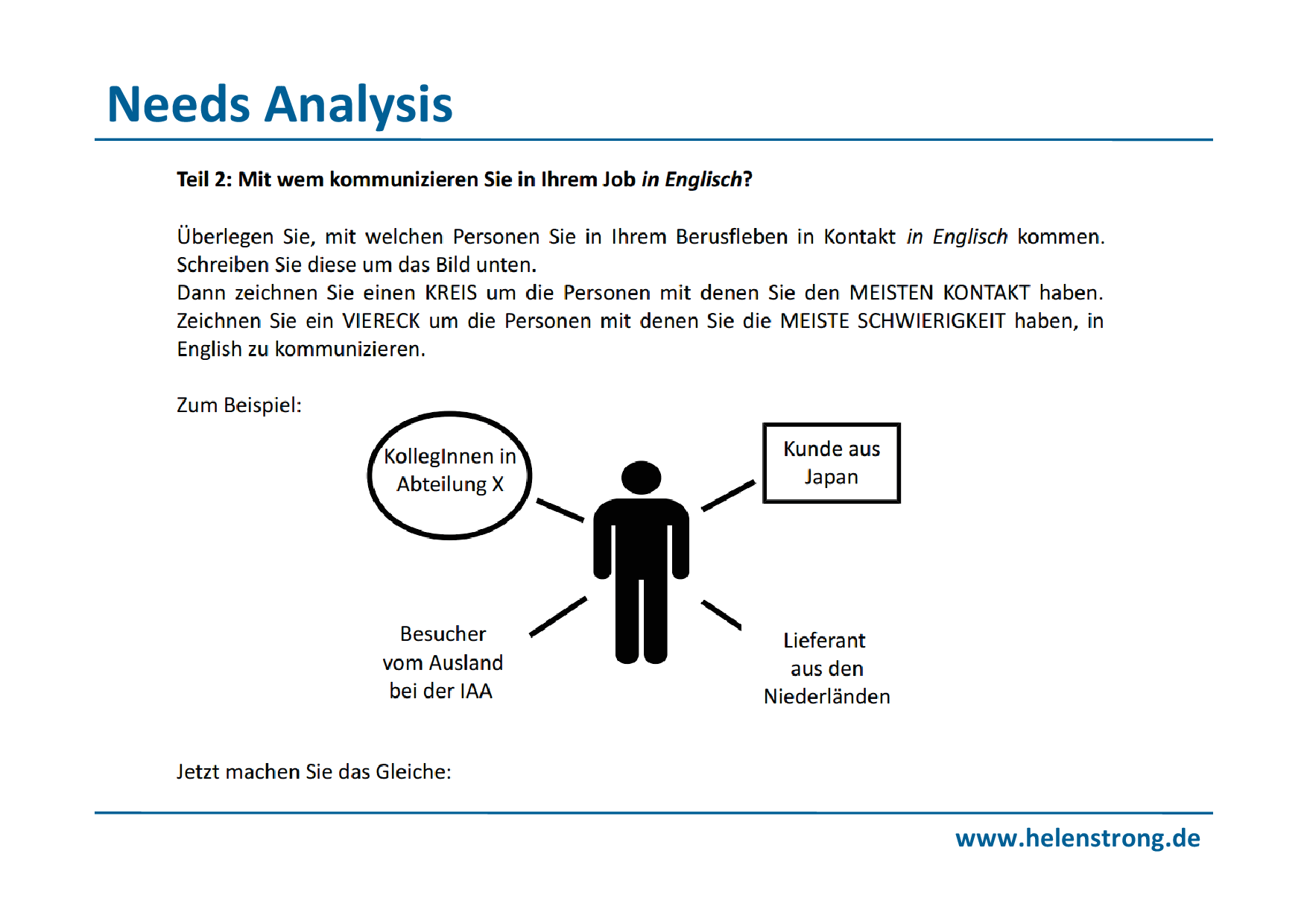
Part two caused some confusion at first, but after some explaining, and some thinking most got the gist of it. This particular cohort only only communicates with two groups of people in English: tenants and Swedish colleagues. So I didn’t get too much new information here, but I think that comes down to this particular situation. In a more varied international setting its value would increase a lot.

Teil 2

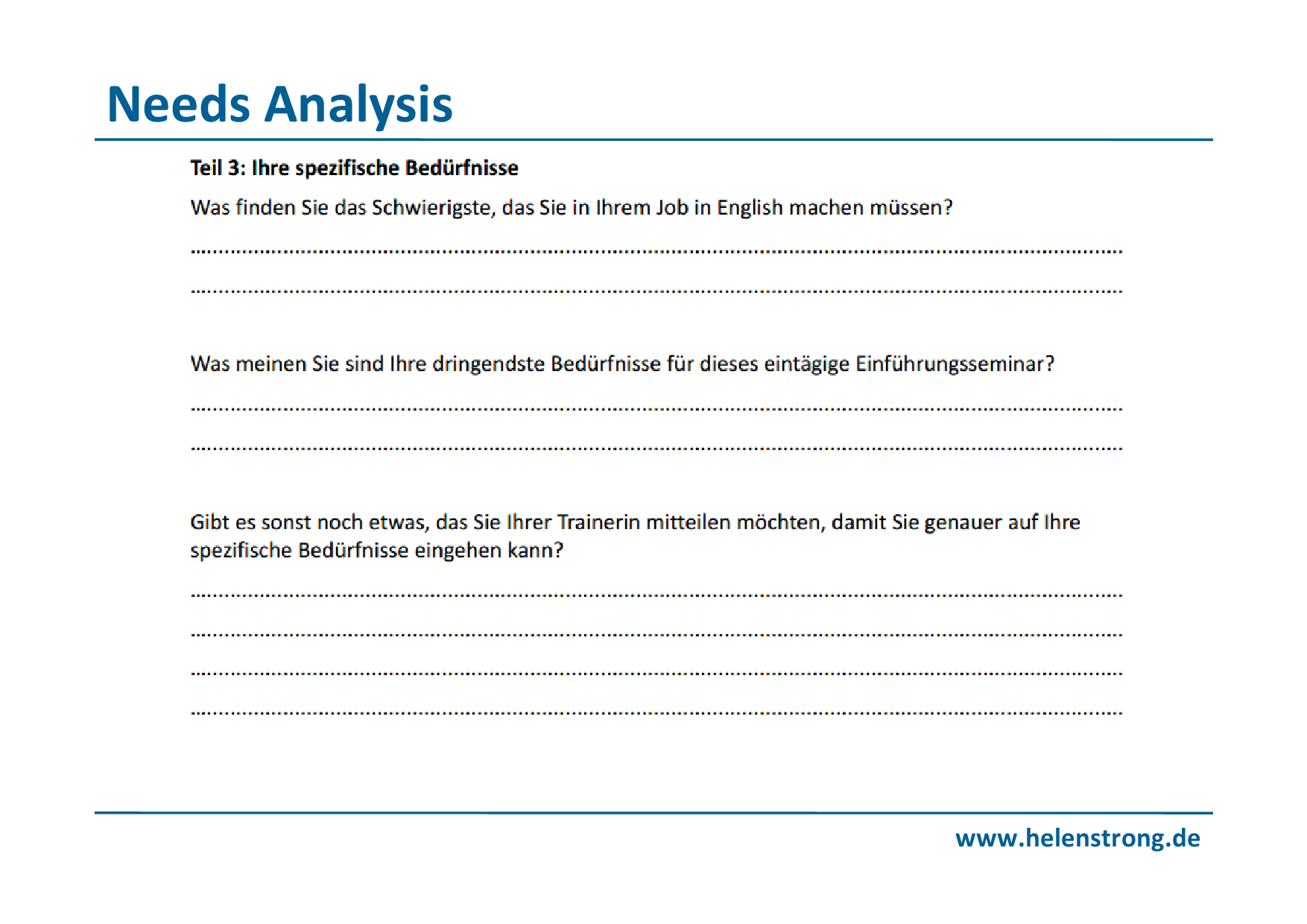
Part Three was particularly interesting. Again no mention of the forthcoming computer system change. However it provided a lot of topics will be used in upcoming lessons. The fact it was in German relaxed the students, although one was frustrated that she couldn’t express herself as she wanted in English. Overall I think that Helen’s advice to allow German at this stage is definitely sound advice. Different students used that permission to differing degrees, some wanting an early start to their practise, others wanting to get their reasons across in German.

teil 3.png

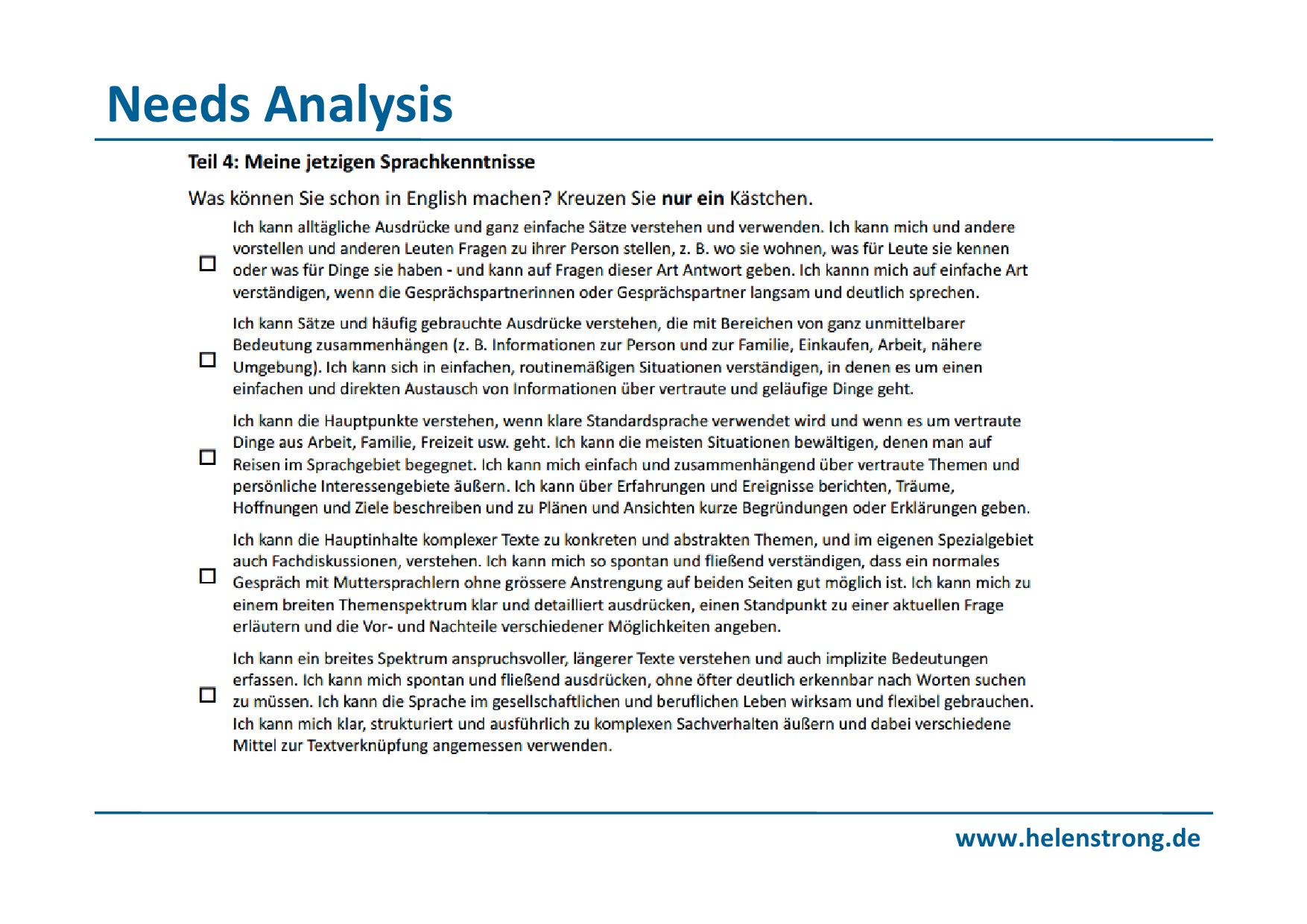
The final section was a description of English language capabilities taken from the CEFR framework. I have to be honest and say I didn’t get much benefit from this, except perhaps a small psychological insight. I found students were very poor at correctly identifying their ability. Some who used English very well were marking themselves as an A1 and others who couldn’t complete a sentence in English were marking themselves as B2. Obviously, there will always be outliers but I’m not sure if I would include it in a needs analysis of my own. Overall, I found the document to be a very useful tool for a BE trainer and I am now firmly on the needs analysis bandwagon.

teil 4.png

After all that, we had a break with a very nice spread laid on by the organisers. What I particularly liked was that Helen was very accessible here, as I had some questions that I wanted her opinion on. It was interesting to hear that networking brought in far more business for her than her website did. Which makes the next Stammtisch with ELTABB even more vital!


After the break we returned with a look at business skills starting with the six classic skills. What Helen did next which I found very interesting was transitioning these into functional skills. The business matrix that she used makes this very straightforward. The key point there sís inter… Rather than learning the six skills in solution, the suggestion is to see how these skills are usually used. I would highly recommend the use of her business skills matrix for devising training sessions when a specific purpose can be identified. Following this was a focus on culture in the workplace and a discussion of how these sometimes difficult issues could be addressed.


The penultimate segment dealt with the difference between International Business English (IBE), where at least one speaker has English as a first language, and Business English as a Lingua Franca (BELF), where none of the participant share English as a mother tongue. I found this idea very interesting, and getting the terminology made this different ideas more concrete. These particular issues and how you deal with them, are taking on increasing influence in Germany and particularly Berlin. The point being that communication and comprehension have to be the key as BE trainers. The week after I found myself saying to a student “That expression doesn’t exist in English” but when she asked me what was wrong, I had to admit there was no mistake. The sentence was grammatically and semantically sound. This prompted the workshop to pop into my head, and this reinforced my decision to change my mind with the reaction to the student. The sentence was acceptable International English, the other students, as well as me, had understood when it was spoken. What Helen Strong focused on, as I understood it,  was making students aware of what barriers to communication might exist, and her argument that language is really the last piece of the puzzle when it comes to BE training seemed particularly apposite here.


The workshop finished with a description of the Cert IBET, which the workshop took a lot of information from and Helen is a provider of. The pitch was good, especially as we all know how much Germany loves certificates! As Helen said, it is something which could make a trainer stand out from the crowd, and my feeling on the day was that some attendees were interested in having her return to Berlin to provide it. I think I might be one of them, so if there are any other like minded members we should discuss it (on Ning of course!)

Overall, there was a lot of interesting point discussed, and as I’ve shown, plenty which can be put into practise. What I liked the most, that I’m definitely planning on using is the business skills matrix, and the necessity of a needs analysis is now a firmly held belief.

What about you? What did you find interesting? Was there anything you disagreed with?  


Don’t forget to check out the slides from the workshop!